
 EN
 English
 Vietnamese
 繁体中文
 Italian
 Spanish
 Thai
 Japanese
 Portuguese
 Korean
 Russian
 French
 German
 Arabic
Stay Updated with Allroad’s
Industry Knowledge
Industry Trends, Product Knowledge & Global Trade Insights

Industry Trends, Product Knowledge & Global Trade Insights

Automotive emergency accessories keep people safe when something goes wrong. A manufacturer's promise of quality means little without documented quality control procedures you can check. Proof is better than a promise for safety gear.
You will go through five groups of questions: whether documents are available, what the documented quality control procedures cover, testing and validation, tracking and record-keeping, and steady improvement.
Use this list as a script for your talk. Ask for manuals, certificates, and test reports in writing. Compare the documents with the answers. Spoken promises fade; paper does not.
Ask for written quality control papers, like manuals and test reports. These show that the manufacturer's quality claims are true.
Make sure the manufacturer follows automotive standards like IATF 16949. Also check that they use core tools such as PPAP.
Ask for lot traceability and record retention policies. This makes sure you can track problems and check quality over time.
Check how the manufacturer deals with defects and changes. Look for written corrective actions and change control procedures.
Sign a quality agreement before you order. This agreement puts in writing the inspection points, test standards, and record keeping.
A written QC manual is the basic proof that documented quality control procedures exist. Ask for the manual itself, not a summary. A good answer describes a current document with a revision number and an owner. A marketing brochure with checkmarks does not count.
You want to see how the manual handles incoming material, in-process checks, final inspection, and nonconforming product. Ask these questions in your email:
Can you send your current QC manual with its revision number?
Who owns and updates the manual?
When was the last revision, and what changed?
A manufacturer with a mature system answers these quickly and without hesitation. Vague replies about "strict control" tell you little.
You can reasonably ask for several documents before you sign anything. Ask for the quality manual, the certificate scope for standards such as ISO9001, sample test reports, and product specification datasheets. The certificate scope matters as much as the certificate. Check that your accessory type falls inside the listed scope.
A manufacturer with an in-house laboratory and published test reports can usually share these documents within days. For example, a supplier with a lab established in 2017, a large library of product specification datasheets, and hundreds of lab and third-party test reports already has the files on hand. Copy this list into your first email:
Quality manual and current certificate with scope
Two or three sample test reports for similar products
Product specification datasheet for the accessory you plan to order
Set a response deadline in your request. Fast, complete answers signal an organized quality system. Slow or partial answers deserve a follow-up before you move forward.
A manual shows a system exists. What's in it shows the system is strong enough for safety-critical parts. You need to see which standards the manufacturer follows and where the checks happen on the line. Ask for the table of contents and a few sample pages. Read them against the questions below.
Start with the automotive quality standard. Ask whether the manufacturer holds IATF 16949 certification, and request the certificate with its scope. ISO9001 is a good baseline, but IATF 16949 adds automotive-specific discipline. Next, ask which AIAG core tools appear in the documented quality control procedures. The five core tools are APQP, PPAP, FMEA, MSA, and SPC. A strong supplier can name each one and show where it lives in the process.
The most telling question is about PPAP. Ask whether the manufacturer can provide a completed PPAP submission for your emergency accessory. A PPAP package shows that the production process was planned, validated, and approved before shipment. Ask these questions in one email:
Do you hold IATF 16949, and what does the certificate scope cover?
Which AIAG core tools do your documented quality control procedures reference?
Can you provide a completed PPAP submission for this accessory?
Which FMEA and control plan documents apply to this product family?
A strong answer names the standards, points to specific documents, and offers samples. General claims about "international quality standards" do not count.
Ask the manufacturer to walk you through inspection gates at each production stage. You want incoming material checks, in-process checks, and final inspection, each with a defined record. Ask about first article inspection and how the team documents it. Request a sample first article report for a similar product.
Material certification matters too. Ask whether the manufacturer provides EN 10204 inspection certificates for metal components. The certificate type tells you what was verified and by whom. Then ask how the team records each gate. A strong answer shows defined inspection points, named records, and sample documents you can review. For example, a supplier with CE, GS, and UL product certifications and a large body of lab and third-party test reports can usually point to the exact report behind each claim. Weak answers stay general. Strong answers name the gate, the record, and the person who signs it.
Ask the manufacturer to list the tests it runs on your type of accessory and the standard behind each one. For emergency hardware, that usually means load and strength tests, salt spray or corrosion tests, and durability cycling. Electrical parts need insulation, continuity, and overcurrent checks. Name the market you sell into and ask which certifications apply there: CE for the EU, GS for Germany, UL for the US. Then ask whether third-party lab reports exist for the exact product family, not just a similar item.
A strong answer names the test standard, gives the report date, and identifies the lab and its accreditation. Ask for the report itself, not a small certificate image. A manufacturer with an established in-house laboratory and a large body of lab and third-party test reports can usually send these files the same week. Copy these questions into your email:
Which tests apply to this accessory, and to which standards?
Can you send third-party lab reports with dates and lab accreditation?
Do you test the finished product or only incoming materials?
Testing the product is only half the story. Ask how the manufacturer proves its own inspection process works. Measurement system analysis shows whether gauges and operators produce consistent readings. Calibration records show whether those gauges trace back to a known reference. Request the calibration schedule and a sample record for the equipment used on your product.
Then ask the direct question: how do you confirm your procedures actually catch defects? A mature supplier describes challenge tests, known-defect samples, or periodic audits of inspection results. It also tracks escapes and reviews them. Vague assurances about "strict inspection" fail this test. Concrete records pass it. A supplier with multiple certifications and a long export track record can usually walk you through these controls without preparation.
Ask the manufacturer to trace one finished accessory backward. Pick a sample from a recent shipment. Then ask for the production lot, the material batch, and the sub-tier supplier behind each component. A supplier with real traceability answers this in days. A supplier without it answers with generalities.
Then ask how the company holds sub-tier suppliers to automotive quality expectations. The Minimum Automotive Quality Management System Requirements for Sub-Tier Suppliers, known as MAQMSR, gives you a named benchmark. Ask whether the manufacturer applies MAQMSR or an equivalent requirement to its own suppliers. Also ask how it verifies compliance. Request a sample supplier approval record.
A strong answer links the lot code on the packaging to a batch record. It also links the batch record to material certificates. Ask for the lot code format and where it appears on the product and the carton. Then ask to see that chain for one product. If the chain breaks at the sub-tier level, you have found a gap worth discussing before you order.
Ask for the retention period for inspection records, test reports, and material certificates. Ask who can access those records. Also ask whether you can receive copies during the contract. A clear retention policy shows the manufacturer treats records as an asset, not paperwork. Put the retention commitment in your quality agreement, so the answer survives staff changes.
Real-time process data is the next level. Ask whether the manufacturer can share live inspection results or process data with you. Not every supplier offers this. A supplier that does shows documented quality control procedures with data visibility. That visibility is a strong sign of maturity. Copy these questions into your email:
How long do you retain QC records, and who can access them?
Can you share real-time process data with customers?
Which sub-tier suppliers touch this accessory, and how do you qualify them?
A quality system earns trust through its daily habits, not its launch day. You need to know how the manufacturer handles problems and changes after production starts. These two areas show whether documented quality control procedures stay active or sit unused.
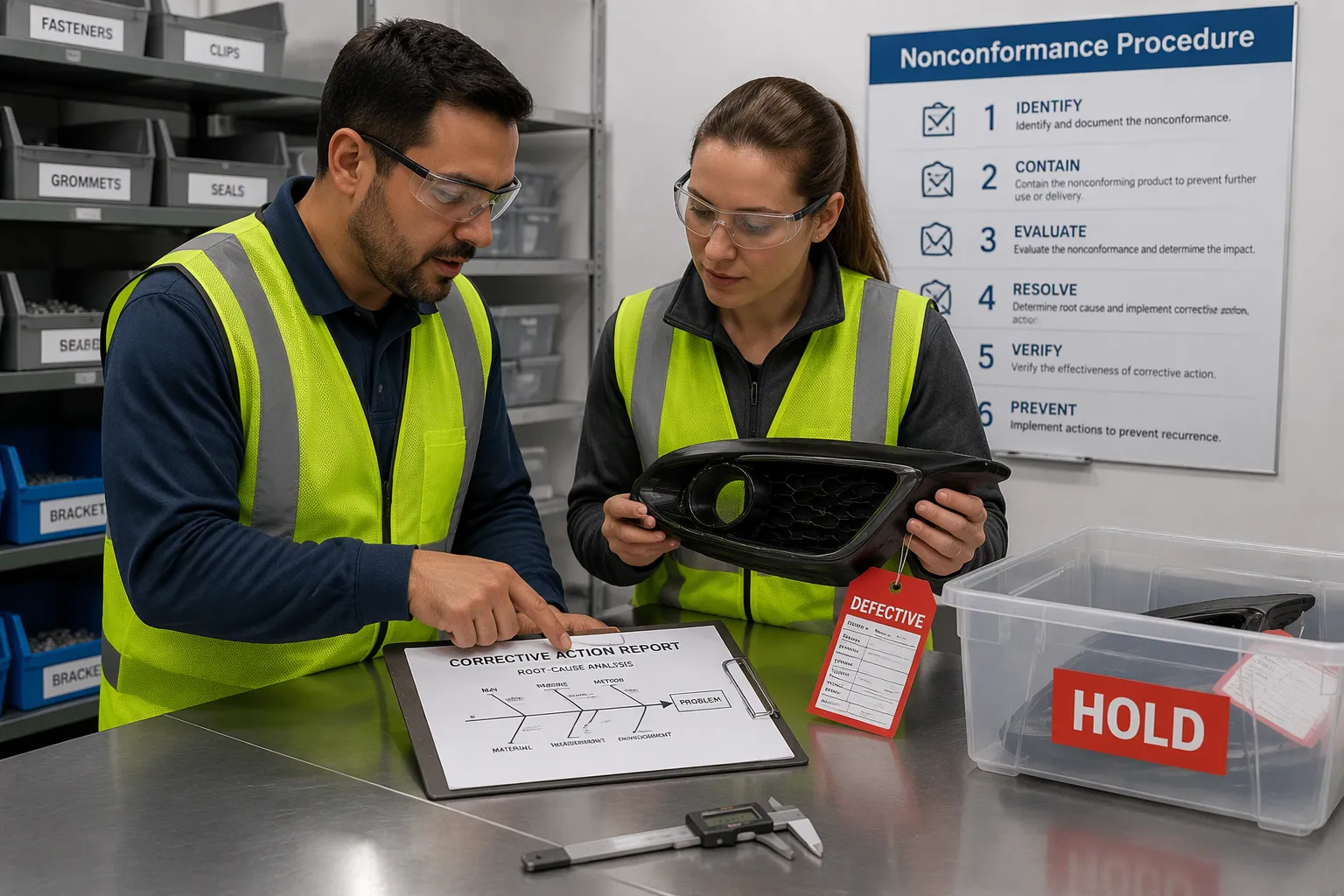
Ask the manufacturer to explain the full path of a defective unit. You want to hear about separation, tagging, and a set hold area. A strong answer keeps suspect material away from good stock before anyone decides what to do next. Then ask who reviews the defect and how the team records the decision: rework, scrap, or concession.
Corrective action is the next step. Ask for the documented corrective action process and a sample report from the past year. Look for a root-cause statement, not just a quick fix. A supplier that writes "operator retrained" without a cause analysis has only treated the symptom. A supplier that traces the defect to a process setting, a gauge, or a supplier batch has treated the cause. Ask how the team checks that the fix worked and how it watches for repeat defects in the months after.
Copy these questions into your email:
How do you separate and dispose of nonconforming product?
Can you share a recent corrective action report with root-cause follow-up?
How do you confirm the corrective action stopped the problem from coming back?
A manufacturer with multiple certifications and a long export track record can usually answer with a real case, complete with dates and results. General statements about "zero defects" tell you nothing about the process behind them.
Process changes can quietly break quality. Ask who approves a change to materials, tooling, suppliers, or process settings. The answer should name a role, such as the Quality Assurance Manager or a similar authority, and a sign-off step. Then ask what paperwork a change requires: a change request, a risk review, updated control plans, and new validation before the first shipment.
Review frequency matters too. Ask how often the team reviews and updates its QC procedures. A fixed schedule, such as a yearly review plus extra reviews after defects or changes, shows the system adapts. Ask for the revision history of one procedure. You will see whether updates happen on schedule or only after a customer complaint.
End the conversation with a written quality agreement or a quality plan made for your accessory. This document should cover inspection points, test standards, record retention, change notification, and corrective action duties. Ask the manufacturer to sign it before the first order. A supplier with an in-house laboratory, CE, GS, and UL product certifications, and customers in more than 50 countries can usually speak to these processes with real examples. Compare those examples against the signed documents, and you will know whether the system will hold up over the life of your contract.
You now have a full set of questions. Ask for the written QC manual. Confirm the standards they cite, including IATF 16949 and the AIAG core tools. Nail down inspection points, test reports, lot traceability, corrective action, and change control.
Request every document in writing. Then check each answer against the paper itself. Verbal assurances fade fast, and a signed quality agreement protects you long after the sales call ends.
Put these questions into your supplier qualification checklist before you place an order. Score each answer against the documents you receive. A supplier who clears that bar earns your business on evidence, not on promises.
Yes. Ask for a written quality plan even on a trial order. The document should list inspection points, test standards, and how long records are kept. A small order still puts your brand on a safety-critical product. Get the signature before production starts.
Ask which elements they can supply instead. A control plan, a process flow diagram, and dimensional results cover much of the same ground. Treat a flat refusal as a warning sign. Many suppliers outside the automotive chain still keep these records.
Look for the lab name, accreditation mark, report date, and the exact product tested. Compare the model number against your datasheet. Call the lab if the report looks unusual. A supplier with a large body of lab and third-party test reports will answer these checks without delay.
A visit confirms what the documents claim. Ask to see the inspection stations, the calibration records, and the hold area for nonconforming product. Watch one inspection gate in action. You will learn more in an hour on site than in weeks of email.
Review the certificate scope and test reports once a year. Ask for an update after any process or material change. Tie the schedule to your quality agreement. Steady review keeps the evidence current and catches drift before it reaches your customers.
To find a reputable luggage strap manufacturer in China, research hubs, vet credentials, test samples, and negotiate clear terms to protect your brand.
Find out more about our news >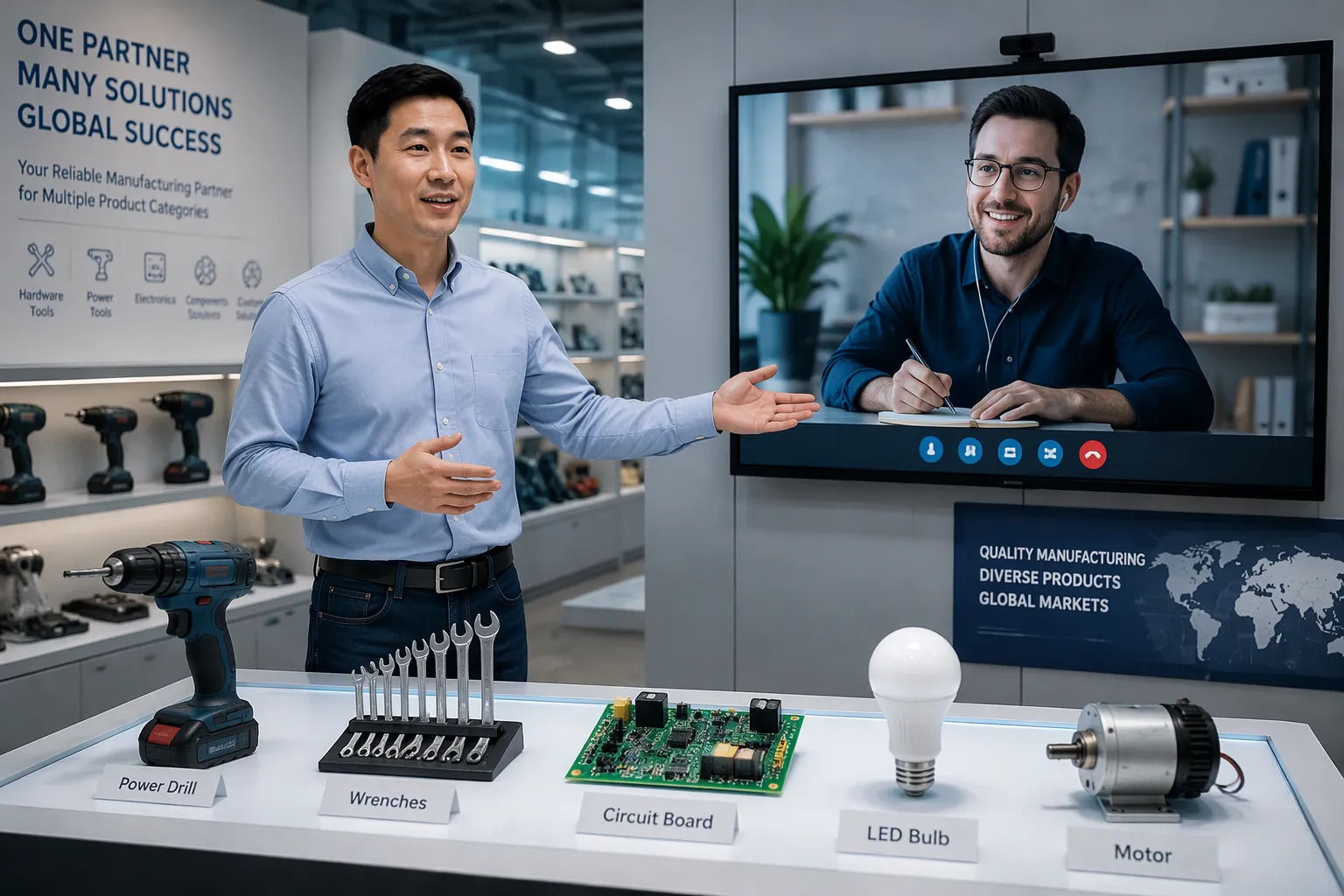
Yes, a Chinese manufacturer can handle multiple hardware product categories if it has in-house processes, compliance, and cost efficiency. Verify with audits and samples.
Find out more about our news >
To recommend a manufacturer for overseas wholesale, evaluate product quality, compliance, cost, capacity, and communication using a weighted scorecard.
Find out more about our news >
To recommend a hardware factory for import orders, check product specs, quality documents, and compliance. Verify the manufacturer and score candidates.
Find out more about our news >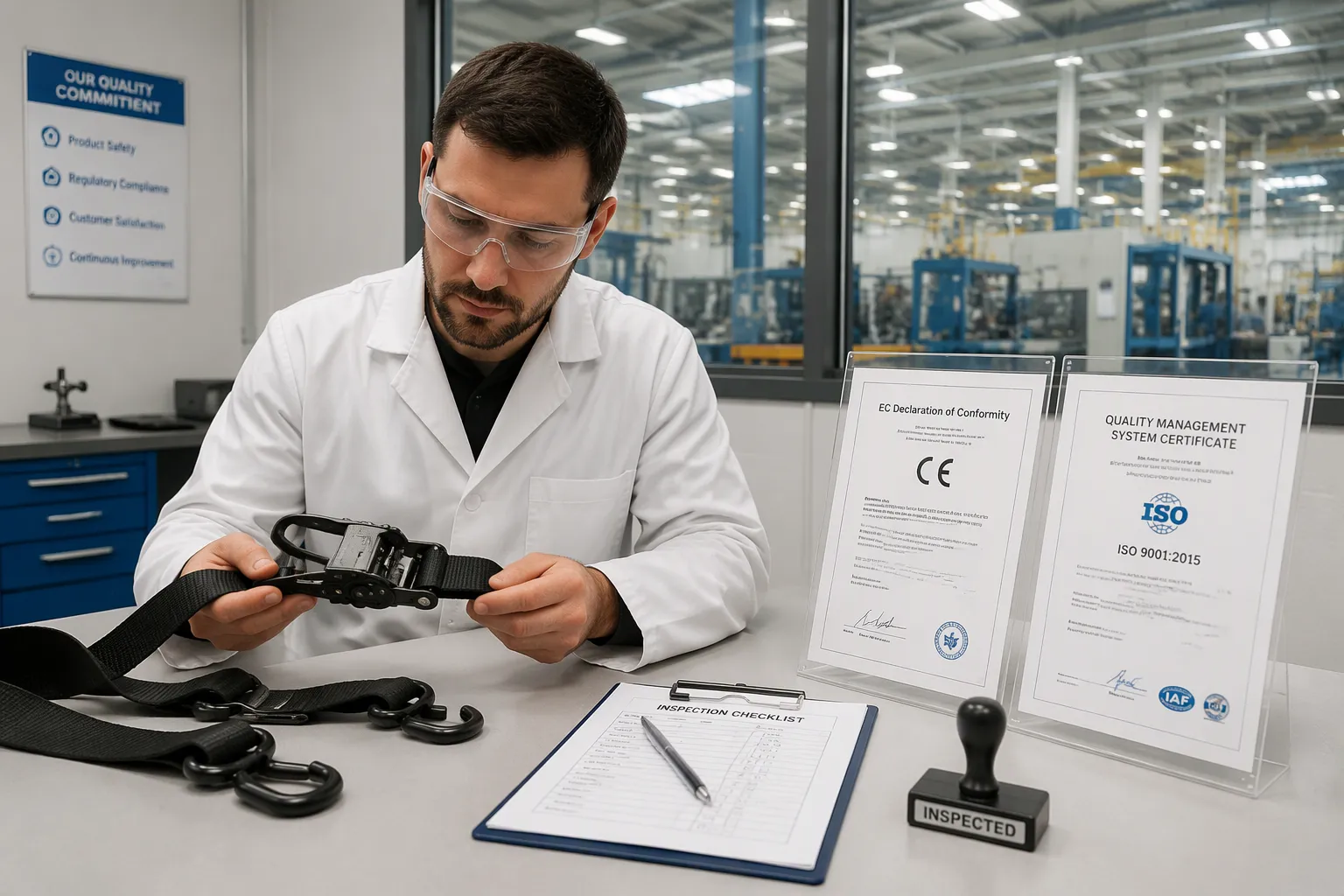
What certifications should I check? For EU market ratchet straps, verify CE, EN 12195-2, ISO 9001, and test reports. Ensure documents are valid and match your product.
Find out more about our news >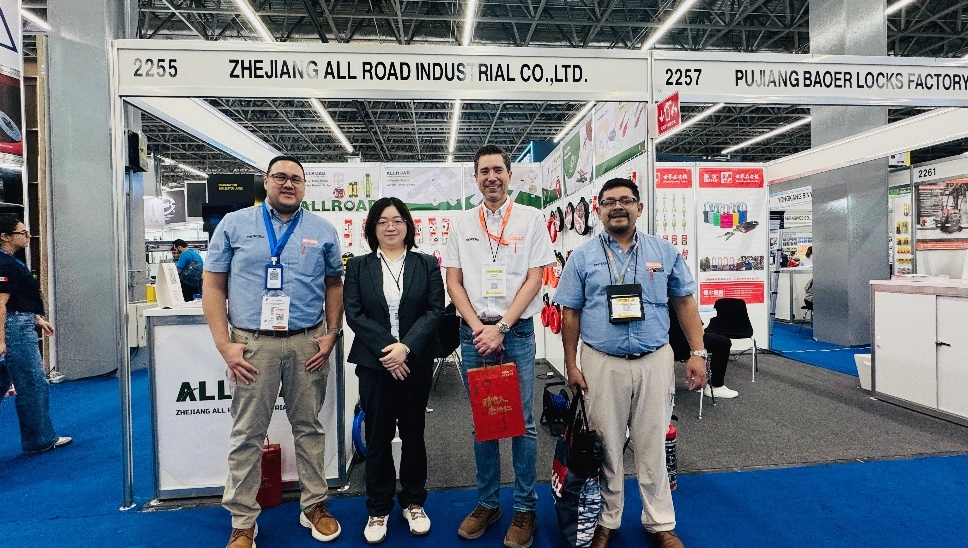
Zhejiang All Road Industrial Co.,Ltd. participated in the Mexico National Hardware Expo with its core products, using this opportunity to deepen its presence in the Latin American market and learn from cutting-edge industry practices.
Find out more about our news >