
 EN
 English
 Vietnamese
 繁体中文
 Italian
 Spanish
 Thai
 Japanese
 Portuguese
 Korean
 Russian
 French
 German
 Arabic
Stay Updated with Allroad’s
Industry Knowledge
Industry Trends, Product Knowledge & Global Trade Insights

Industry Trends, Product Knowledge & Global Trade Insights
Your overseas partners expect a name, not a shortlist. When you recommend a manufacturer for your wholesale program, the recommendation must hold up to review by distributors, compliance teams, and management.
The answer is a structured evaluation process built on five criteria: product quality, regulatory compliance, cost-effectiveness, supply capacity, and communication reliability. Each criterion turns into evidence you can request, check, and compare across candidates.
This post walks through each stage in order. It ends with a scorecard you can use on any candidate before you recommend a manufacturer to your partners.
Figure out exactly what your wholesale business needs before you reach out to any manufacturer.
Check the product's quality and make sure it meets the rules by looking at tests and certificates.
Look at the total landed cost, not just the unit price.
Make sure the manufacturer can handle the work and communicates reliably.
Use a scorecard with weights to make a recommendation based on evidence.
Begin with a written list of every product type you plan to buy. Write down the yearly amount for each item and the number of SKUs you expect to carry. A wholesale program with a small range and high volume points to a different manufacturer type than one with a wide mix and low volume per item. Large manufacturers fit high-volume, standard orders. Specialized manufacturers fit technical or niche ranges. Regional manufacturers fit smaller programs with short delivery distances.
Buyers who source beyond emergency accessories should define each category's needs on its own. Suppose you compare wholesale locksmith supplies alongside auto hardware. Treat locksmith supplies wholesale as its own set of needs before you combine everything into one supplier evaluation. Locksmith supplies wholesale buyers often order in different amounts than auto hardware buyers. The same rule applies to wholesale locksmith parts, bulk keys and remotes, and bulk remotes. Each category has its own volume pattern, technical demands, and compliance needs. Mixing them too early blurs the shortlist and weakens your recommendation. A program that adds wholesale locksmith supplies later should repeat this step for the new category, and locksmith supplies wholesale volumes should stay separate from auto hardware totals.
List every destination market for your program. Record the rules, voltage standards, and labeling requirements that apply in each one. A product approved for one market may need extra certification for another. International buyers often run multi-market programs, so your shortlist must reflect every destination, not just the largest one.
Target markets also shape product fit. Climate, road conditions, and vehicle mix decide which emergency accessories sell best in each region. A wholesale supplier serving cold climates needs different product specs than one serving tropical markets. Write these needs down before you contact any candidate. This step keeps your evaluation fair and gives every manufacturer the same brief. Wholesale buyers who document market needs early make faster, cleaner decisions later.
Ask each candidate to show proof for its technical claims. Lab tests done in-house and test reports from outside companies turn a sales promise into evidence you can check. Well-known manufacturers often share spec sheets and test records, so you can compare candidates the same way.
The criteria you test depend on the accessory. Use this table as your checklist:
Accessory | Core performance criteria tested |
|---|---|
Fire extinguisher | Gauge needle in green charge zone; pin and tamper seal unharmed; firmly mounted (not loose); inspection tag up to date; nozzle clear; correct UL rating (5 B:C minimum, or 10 B:C for placarded hazmat) |
Warning triangles | All three there; reflective faces clean and not damaged; legs fold out and stand up straight; stored within quick driver reach |
Spare fuses | There; correct amperage for circuits; not already used; stored dry, labeled, and easy to find |
Stowage/accessibility (all items) | Gear must be reachable within ~10 seconds in an emergency; secured so it lasts through the miles |
Every extinguisher must be labeled with its Underwriters' Laboratories rating and built so you can visually confirm it is fully charged, filled, and firmly mounted; the pressure indicator should be checked on every pre-trip inspection, since a broken seal or low charge makes it useless.
How much documentation a manufacturer keeps shows how seriously it treats quality. Take ALL ROAD as one example: started in 2004, it set up an in-house lab in 2017 and keeps 142 product spec sheets plus 216 lab and outside test reports. That much paperwork lets you check claims before you commit wholesale volume. By itself, though, it does not make one option better than another.
Technical performance means little if the product does not fit the use. Cold climates put stress on plastic housings and battery chemistry. Tropical markets put stress on reflective films and metal parts. Ask each candidate how its products hold up in your destination markets, and ask for test evidence tied to those conditions.
Compare the answers against your written market brief. A manufacturer that tests for your climate and use case gives you a stronger basis for a wholesale recommendation. Weigh the evidence, not the brochure.
Certifications show that a manufacturer meets set standards. Look for ISO 9001:2015, TUV/GS, CE, UL, and RoHS. The rules of your destination market decide which ones apply to your order. A CE mark matters in the European Union. A UL listing matters for electrical items sent to the US. RoHS limits harmful substances in electrical goods. ISO 9001:2015 shows a quality management system that works.
Build a compliance matrix before you contact candidates. List each product, each destination market, and the certificates that market requires. Then ask every manufacturer for current certificates, not expired copies. Make sure the certificate scope covers the exact product you plan to buy. A certificate for a related item does not cover your item.
US-bound programs need extra care when you expand into nearby categories. Buyers adding wholesale keys and remotes in the USA must confirm separate compliance and paperwork for those items. Wholesale keys and remotes in the USA often fall under different rules than emergency hardware. Transponder keys and programmable remotes may carry radio-frequency or security requirements. Remotes and keys in the USA need their own test records. Remote controls and transponder keys from one line do not automatically clear another. Treat wholesale keys and remotes in the USA as a separate compliance track.
Paperwork readiness gives another signal. A manufacturer with global export compliance certifications and authorized patents usually keeps its paperwork in order. ALL ROAD, as one example, holds 38 authorized patents and 16 global export compliance certifications. Such records suggest a manufacturer can support your export filings without last-minute scrambling.
Paperwork errors cause delays, re-labeling, and added costs at the border. Review the documents a candidate can supply against the requirements below.
Requirement Category | Specific Requirements |
|---|---|
Marking and labeling | Permanent marking and legible labels visible to the end user; missing or incorrect marks trigger delays and re-labeling costs |
Commercial invoice | Detailed product descriptions covering material composition and function, plus quantity, unit and total value, and country of origin; vague terms such as "safety equipment" are discouraged |
Packing list | Product breakdown, quantities, and carton details, especially for mixed shipments |
Additional documentation | Certification documents, test reports, compliance declarations, and technical specifications as the product type requires |
Country of origin | All imported goods must be marked with country of origin |
Ask each candidate for a sample document set. Check that descriptions name the actual product, such as a reflective vest with high-visibility strips or an LED strobe warning light. Confirm the country of origin appears on the goods and the invoice. International buyers who check classification before shipping avoid most border surprises. Exporters and international buyers alike should keep complete records and list mixed products separately on the paperwork.
Destination-country import requirements differ, so confirm them for every market on your list. Sellers of locksmith supplies wholesale face the same rule: each category needs its own labels and declarations. Locksmith supplies wholesale orders that mix product types need a packing list that separates them clearly. Apply this check to every candidate, and your export program will clear customs with fewer holds.
A low unit price can hide a big final bill. Landed cost is the full amount you pay to get goods into your warehouse. It covers the unit price, freight, insurance, duties, and handling fees. Ask each candidate for a wholesale quote that lists these items one by one. A quote with one lump sum does not tell you much.
Make a landed cost estimate for every candidate. Add the freight charge, the duty rate for your destination market, and any port or brokerage fees. International buyers who compare only unit prices often choose the wrong supplier. A manufacturer with a slightly higher unit price may still win on total cost. Its location, shipping terms, and packaging choices can lower freight and handling charges.
Payment terms affect your cash flow and your risk. Ask about deposit size, when the balance is due, and which payment methods are accepted. A supplier that offers flexible terms helps your wholesale program run smoother. Confirm the terms in writing before you commit.
Cost flexibility matters more as order volume grows. Ask whether the manufacturer gives bulk discounts at higher quantities. A clear discount schedule helps you plan pricing for your own customers. For export orders, confirm who handles customs procedures and whether the supplier works with a u.s.-based freight forwarder. A u.s. freight forwarder can make port handling and document flow simpler. Some manufacturers also quote delivered prices through their own logistics partners. Compare those offers against your own freight estimates. The goal is a total cost you can predict and defend in your recommendation.
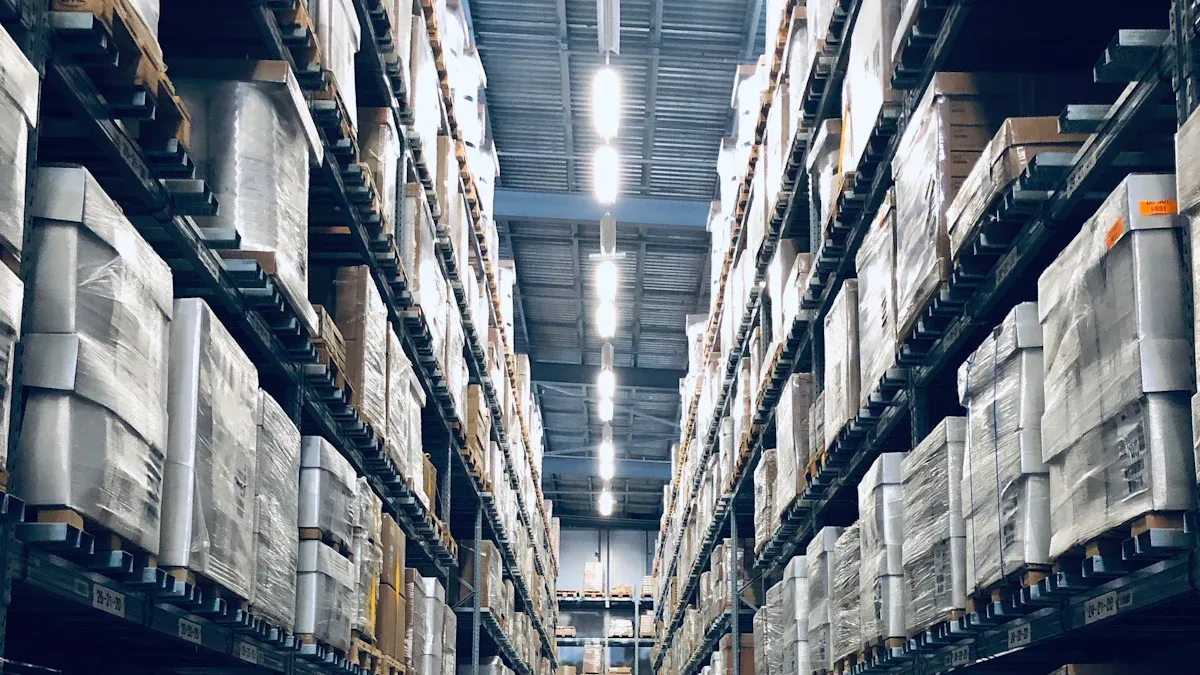
Capacity answers one question: can the manufacturer fill your orders on schedule, month after month? Ask each candidate for its monthly output per product line and its normal lead time. Then compare those numbers against your own volume plan. A manufacturer with extra capacity can handle seasonal peaks. One running near its limit will delay your shipments when demand spikes.
Tier thinking helps you understand the answers. Tier-1 suppliers with a proven record serving major companies usually offer stronger capacity guarantees. Tier-2 and tier-3 suppliers may fit smaller or specialized programs. Neither tier is better in every case. Match the tier to your program size and your comfort with risk. International buyers who plan multi-market rollouts should confirm capacity for every destination, not just the first one.
Scalability decides whether a wholesale supplier can grow with your program. Overseas subsidiaries and joint-venture factories can shorten lead times, because production sits closer to your markets. Ask where each candidate makes your products and whether it runs satellite plants. A manufacturer with sites in several regions spreads its risk and ships faster.
Inventory practices matter too. Lean inventory and fast product turnover support scalability. A manufacturer that refreshes its line quickly can adjust to your changing mix without long delays. Ask how often it introduces new items and how it manages stock between production runs.
Documentation backs up these claims. ALL ROAD, as one example, runs subsidiaries and joint-venture factories in Thailand, North America, and other regions. Such a footprint suggests shorter lead times for export programs. Weigh the evidence against your own volume plan. Reliability comes from verified capacity, not from a promise. Check references from international distributors and other trusted suppliers before you commit wholesale volume. A supplier that serves established distributors usually shows a steadier record. Apply this check to every candidate on your shortlist.

Test how a candidate communicates before you place a large order. Send a technical question and a sample request. Track the reply time, how clear the answer is, and whether the manufacturer follows up on its own. A responsive partner answers in plain terms and confirms details in writing.
OEM/ODM service capability belongs in this check. Ask whether the manufacturer offers design flexibility and how fast it turns around samples. Fast sample turnaround shows a partner that can adapt to your program. A wholesale supplier that handles custom work smoothly will likely handle order changes the same way. Confirm these points for every category you source, including wholesale locksmith supplies, because design support needs differ by product type.
Warranty terms vary by who buys the goods. Use this table to compare coverage across purchaser types:
Purchaser Classification | Warranty Duration / Coverage | Transferability |
|---|---|---|
Licensed Repair Facility | Six (6) Month Part-Only Limited Warranty | Non-transferable (original transaction only) |
Direct Consumer | Six (6) Month Part-Only Limited Warranty | Non-transferable; excludes commercial/fleet/rental/taxi/rideshare use |
Qualified Auto Recycler / Salvage Yard | Ninety (90) Day Part-Only Trade Warranty | Non-transferable; recycler solely responsible for downstream warranties |
Broker / Parts Broker / Intermediary | NO WRITTEN WARRANTY (unless expressly stated on invoice) | May not transfer or represent manufacturer warranty to its customer |
Ask how the manufacturer handles claims. A clear process sets a decision window: the supplier must approve or disapprove each claim within 30 days of receipt. Any claim not disapproved in writing within 30 days is deemed approved, and payment follows within 30 days. Disapproved claims need written notice with specific grounds, and the buyer may resubmit within 30 days. Manufacturers may audit claims for up to one year after payment.
Confirm after-sales terms per category when your assortment includes wholesale locksmith supplies. Warranty and replacement norms differ across product types, so locksmith supplies wholesale terms should stand apart from auto hardware terms. Document each category's terms before you recommend a manufacturer for your export program.
Turn each earlier section into one scored criterion. Your scorecard should have six: technical performance, application fit, regulatory compliance, landed cost, capacity, and communication. Give each one a weight that shows your business priorities. All weights must add up to 100%. A wholesale program with costly returns should raise the weight on quality. A program with tight cash flow should raise the weight on landed cost. The scorecard turns six separate checks into one number you can compare. The scorecard gives you the evidence to recommend a manufacturer with confidence.
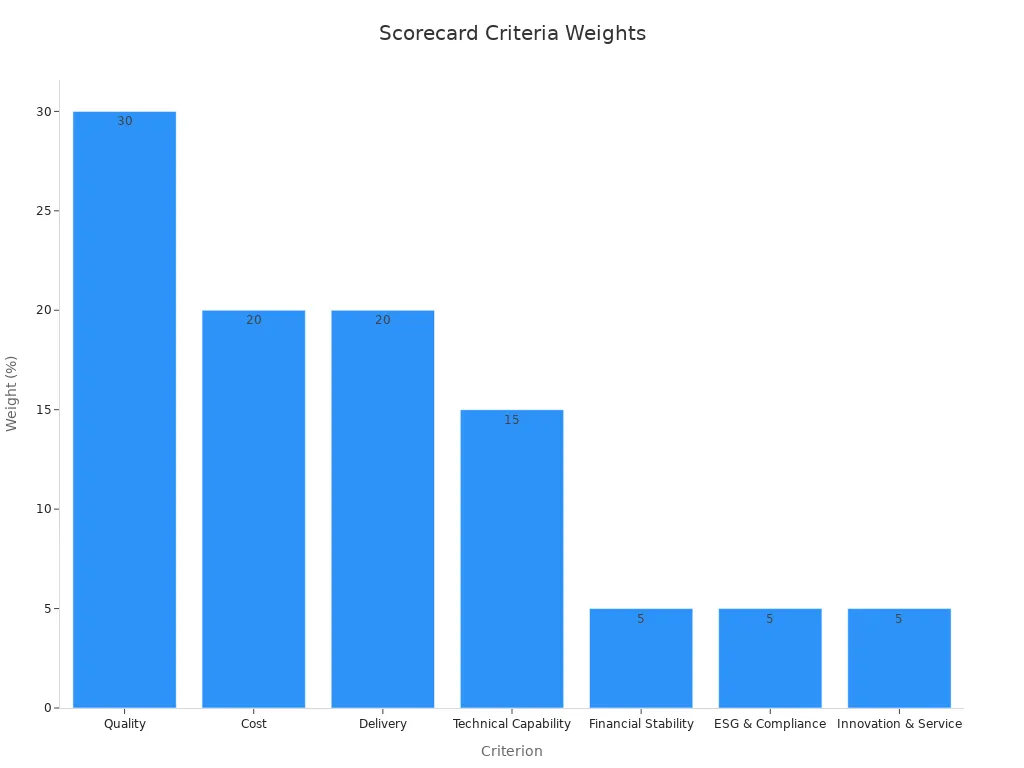
Weights differ by program. A cost-driven wholesale program may put 30% on price and total cost of ownership. A compliance-heavy program may shift weight toward certification and documentation. One published scorecard sets Quality at 30%, Cost at 20%, Delivery at 20%, Technical Capability at 15%, Financial Stability at 5%, ESG & Compliance at 5%, and Innovation & Service at 5%. Use that structure as a starting point, then adjust it to your own priorities. Keep the list to six or eight criteria so your wholesale team can apply it the same way every time. Write the weights down before you score any candidate. Fixing weights first stops a strong sales pitch from bending the result. Review the weights with your partners before scoring begins.
Score every candidate on the same scale, usually 1–5 or 1–10. Define what each score means before you start. A top score should require evidence, such as a current certificate or a passing test report. Use the same scale for all suppliers, or the totals will not compare. Multiply each score by its weight, then add the results. This produces an objective, comparable ranking. The method often shows that the lowest-cost supplier is not the best overall choice. The highest weighted score may come from a supplier offering the best mix of cost, quality, risk mitigation, and strategic alignment.
Selection Criterion | Weight | Supplier A (score/weighted) | Supplier B (score/weighted) | Supplier C (score/weighted) |
|---|---|---|---|---|
Price & Total Cost of Ownership | 30% | 7 (2.1) | 8 (2.4) | 6 (1.8) |
Quality & Performance | 25% | 8 (2.0) | 6 (1.5) | 9 (2.25) |
Innovation & Agility | 15% | 6 (0.9) | 9 (1.35) | 7 (1.05) |
ESG & Sustainability | 15% | 9 (1.35) | 7 (1.05) | 8 (1.2) |
Risk & Resilience | 15% | 8 (1.2) | 7 (1.05) | 9 (1.35) |
Total Weighted Score | 100% | 7.55 | 7.35 | 7.65 |
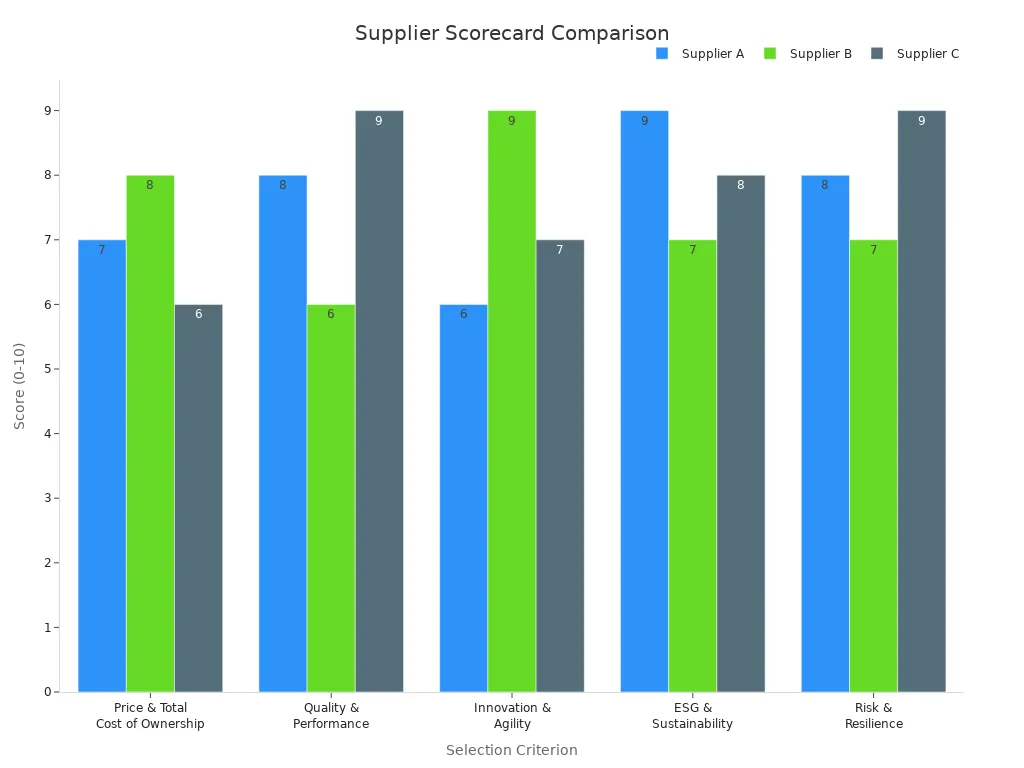
Write down the reason behind every score. Note the test report, certificate, quote line, or email that supports it. Record the evidence next to each score in a one-page memo per candidate. This record lets you recommend a manufacturer to partners and management with evidence in hand. It also shows where each manufacturer type fits best. A large manufacturer may lead on capacity and cost. A specialized manufacturer may lead on technical performance and application fit. A regional manufacturer may lead on lead time and communication. No single type wins every criterion, so present the fit rather than a universal ranking. State the runner-up and the gap in total score. A close gap signals a judgment call; a wide gap signals a clear winner.
Apply the scorecard to every shortlisted wholesale supplier before you recommend a manufacturer. Revisit the weights as markets and regulations change. A documented, weighted score turns a judgment call into a clear decision you can stand behind.
You now have a path you can repeat. Define your needs, check technical fit, verify compliance, figure out landed cost, confirm capacity, and assess communication. Run these steps in order for every candidate.
The scorecard turns those six checks into one clear number you can compare. It gives you evidence to recommend a manufacturer to partners and management with confidence.
Use the scorecard on every shortlisted supplier before you commit wholesale volume. Revisit the weights as your markets and regulations change. A documented decision stays defensible long after the first wholesale order ships.
Put three to five candidates on your shortlist. This range gives you enough to compare without burying your team in paperwork. Score each one on the same six criteria. A shortlist of three often shows a clear leader. Five candidates work well for complex programs with several product categories.
Start with current certificates and test reports. Ask for spec sheets that cover your exact product, not a related item. Request a sample document set: invoice, packing list, and origin marking. This first batch of evidence filters out weak candidates fast. You save time for deeper checks on the strong ones.
Define each category's needs on its own first. Buyers comparing wholesale locksmith supplies alongside auto hardware should set separate volume, compliance, and warranty terms. The same rule applies to locksmith supplies wholesale orders. Combine the categories into one scorecard only after each set of requirements is clear. This keeps your evaluation fair.
Yes. Programs adding wholesale keys and remotes in the usa must confirm separate compliance and documentation for those items. Transponder keys and programmable remotes may carry radio-frequency or security requirements. Treat wholesale keys and remotes in the usa as their own compliance track. Keep those records apart from your emergency hardware files.
Review the weights at least once a year and after any major regulation change. Markets shift, and a criterion that mattered last year may carry less weight now. Re-score your shortlisted wholesale suppliers against the updated weights. A documented, current scorecard keeps your recommendation defensible to partners and management.
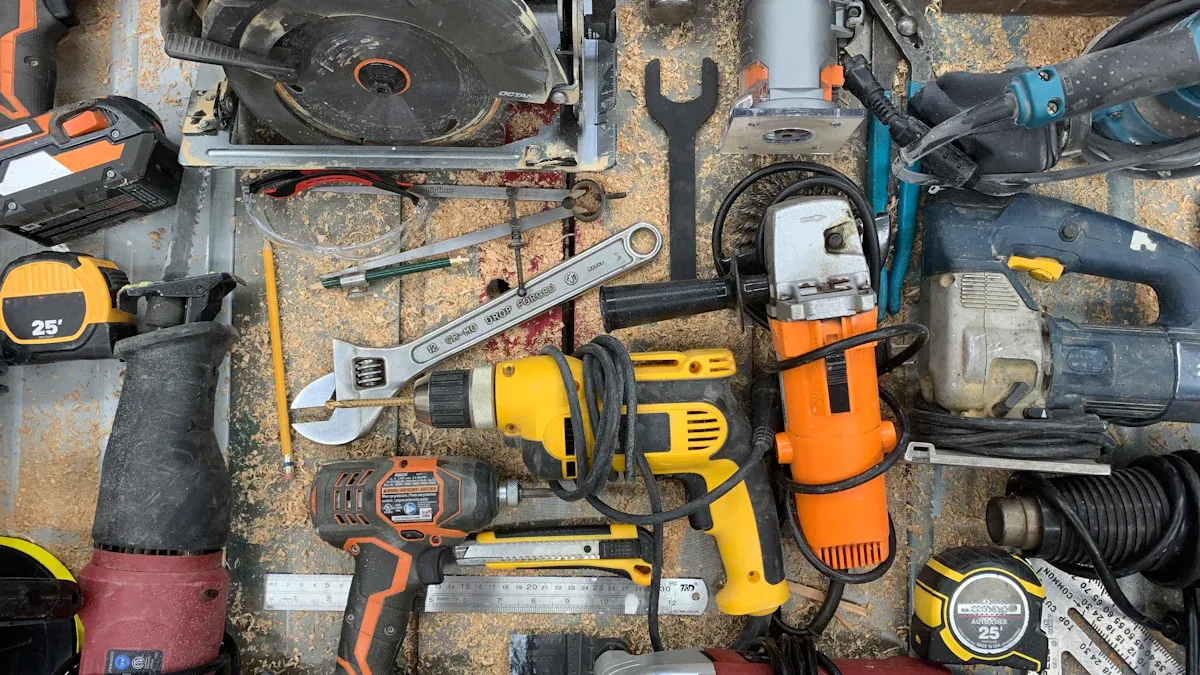
Identify a suitable manufacturer in China for fish tape tools by checking specs, capacity, certifications, customization, cost, and contracts. This checklist guides you.
Find out more about our news >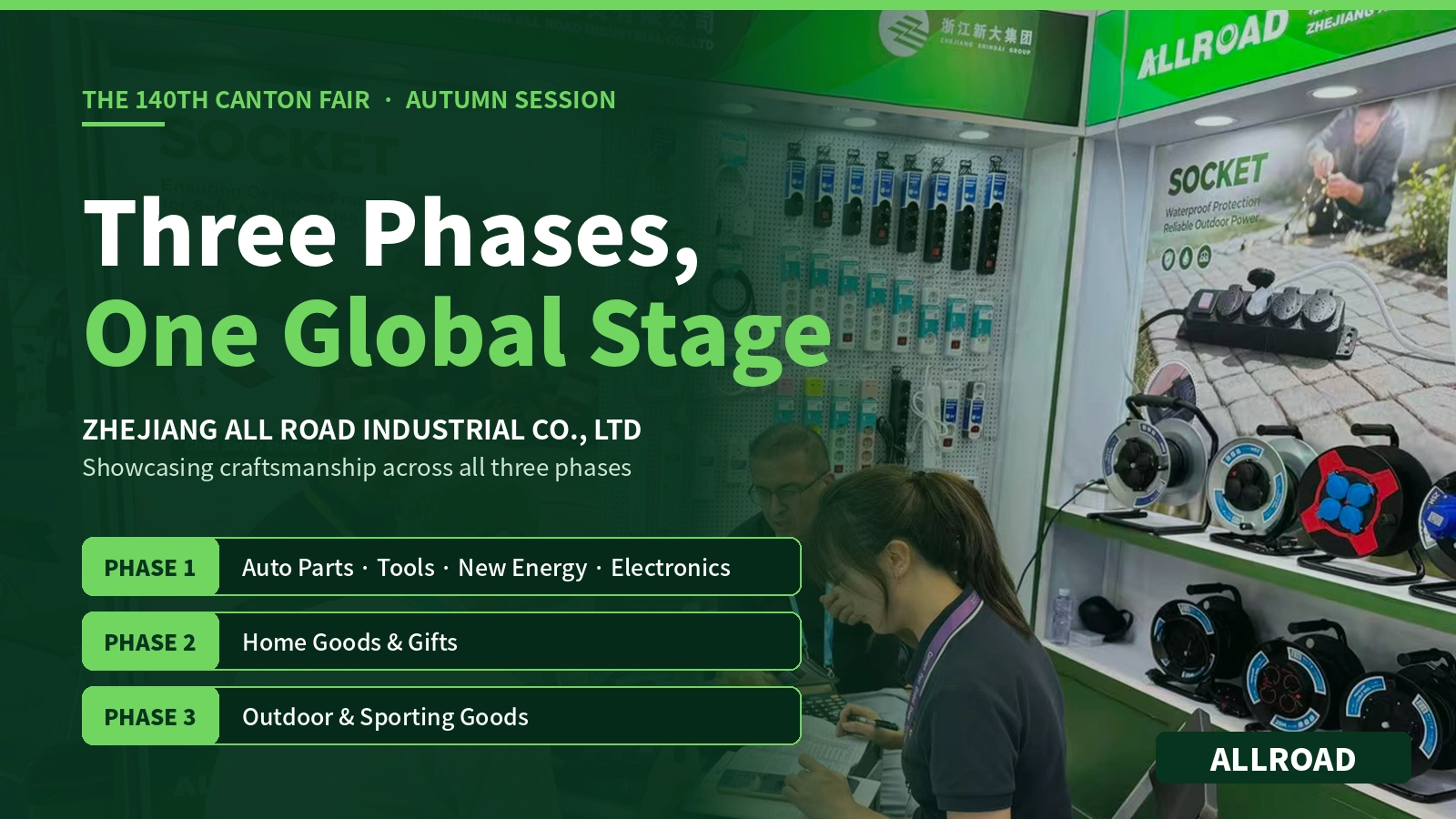
Zhejiang All Road Industrial Co., Ltd. Showcases Craftsmanship at the 140th Canton Fair (Autumn Session) and Engages Buyers from Around the World
Find out more about our news >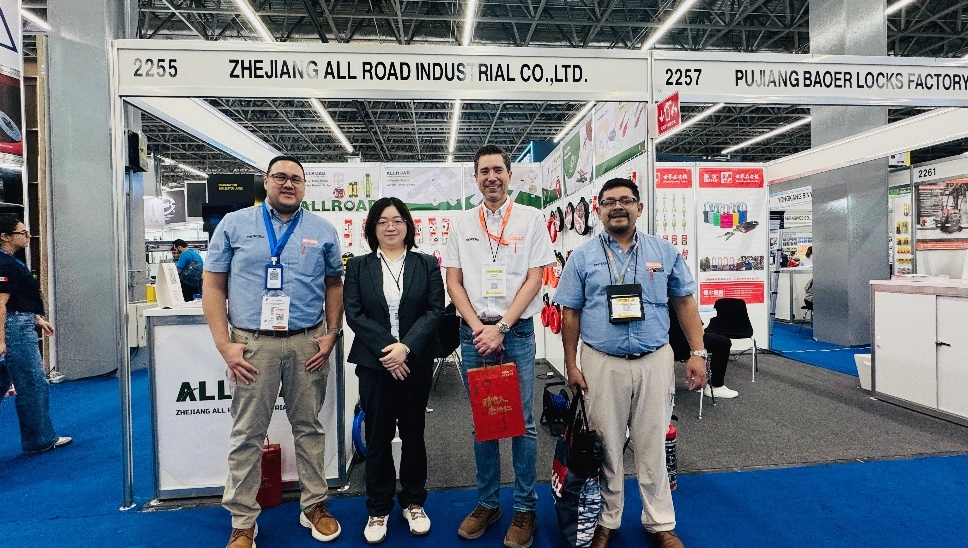
Zhejiang All Road Industrial Co.,Ltd. participated in the Mexico National Hardware Expo with its core products, using this opportunity to deepen its presence in the Latin American market and learn from cutting-edge industry practices.
Find out more about our news >
Learn how to vet Chinese manufacturers for ratchet tie down straps: verify credentials, request samples, and conduct inspections to secure a reliable wholesale partner.
Find out more about our news >
When selecting a cargo nets factory for automotive or outdoor projects, check material quality, certifications, customization, and production capacity.
Find out more about our news >
Ensure your import business thrives by checking these 5 critical factors in a dependable supplier of hardware tools, from quality to communication.
Find out more about our news >