
 EN
 English
 Vietnamese
 繁体中文
 Italian
 Spanish
 Thai
 Japanese
 Portuguese
 Korean
 Russian
 French
 German
 Arabic
Stay Updated with Allroad’s
Industry Knowledge
Industry Trends, Product Knowledge & Global Trade Insights

Industry Trends, Product Knowledge & Global Trade Insights

To recommend a hardware factory for import orders, start by checking one thing: can the supplier provide complete product specifications and supporting quality documents? That one test separates reliable partners from risky ones. A clear evaluation process gives you a clear answer.
This guide walks you through that process step by step. You will list the documents your destination market requires, check each factory's documentation capability, and test product performance for your use case. Next, you verify the supplier is a real manufacturer and confirm compliance certificates. Finally, you compare documentation costs and score candidates against your checklist before you commit.
Make a list of all the papers your destination market needs before you contact any factory.
Ask each factory for a full set of product specs and quality reports for every SKU.
Make sure the factory is a real maker of the goods. Also check that its certificates are valid and cover your products.
Compare the cost of documents and ongoing support, not just the unit price.
Compare factories to your checklist and make sure they will give you updated documents after shipment.
Start with the destination market, not the factory. Import document rules differ by country, and they can change from one shipment to the next. Check the destination country's import rules before you place any order. Customs officials will ask for papers that match their own rules, not the supplier's standard packet.
Each market sets its own list. A European border agency may ask for different proof than a US one. Check the national customs portal and the product safety authority for your exact document requirement. Confirm the format too. Some agencies accept digital files. Others want signed originals with a wet stamp.
Build your list around the product category. Hardware items with electrical parts often carry extra rules. Ask the factory which certificates it already holds for that market. Then compare its answer against the official list. Any gap becomes a question for the supplier.
A written checklist keeps every quote easy to compare. Include these items:
Product specification datasheets for each SKU
Raw material certificates of conformance from the mill or resin supplier
Special process certificates, such as plating or heat treatment
Lab and third-party test reports
A General Certificate of Conformity (the CPSC publishes a model certificate that manufacturers and importers can adapt)
Add a specific material certificate whenever your buyer demands traceability for a grade or alloy. Request a certificate of compliance for regulated categories. Store every document in one shared folder. Label each file by SKU and revision date. This habit makes later audits fast and simple.
A complete document set protects your shipment. It also gives you a fair basis for comparing factories on quality and price.
A factory's paperwork shows you how it runs its production line. Ask for proof before you talk about price. This step shows you whether the plant can handle an import order with steady records.
Send the factory a short written request. Name the SKUs you plan to order and the markets you will ship to. Ask for one complete sample document set for each SKU. A strong reply comes as one organized folder, not as scattered photos on a chat app.
Set up your request as a simple step-by-step list:
Ask for the product specification datasheet for each SKU.
Ask for the material certificate for every graded material in the bill of materials.
Ask for test reports from the factory lab and from outside labs.
Ask for a sample certificate of conformance for one finished item.
Ask for the plant's Quality Management System manual and the scope of its registration.
Read the Quality Management System file with care. A written system lists its procedures, its rules for keeping records, and its inspection points. Check the supplier terms next. Payment, lead time, and claim handling should all be in writing. Read the quality requirements part of the contract too. It should state the acceptance rules for each defect class.
Direct import programs often publish policy and procedures manuals. These manuals explain vendor documentation and quality requirements in plain words. Use one as a benchmark when you judge a factory's packet. Compare the factory's records against that benchmark, item by item.
A thick folder means little by itself. Test the contents with three questions. Is every SKU covered? Does each report carry a date inside the current review cycle? Do the numbers agree across files?
Cross-check the details. The material grade on the datasheet should match the grade on the material certificate. The test method on the report should match the method named in the specifications. The certificate of conformance should list the same model numbers you plan to import. One mismatch is a warning sign. Several mismatches point to weak document control.
Look at the manufacturer's own audit records as well. Internal inspection logs and corrective action reports show whether the plant follows its written system. A factory with solid quality assurance practices keeps these records current and easy to find.
Score each packet on coverage, accuracy, and freshness. A complete, accurate set of supporting documentation gives you a fair basis for the next stage. A thin or inconsistent packet tells you to keep looking.
A datasheet only helps when it matches your job. Read each specification against the real conditions of your application. Check the load rating, the working temperature range, and the duty cycle your product will face. Compare the tolerance bands on the drawing with the fit your assembly needs. A clearance that works in a showroom may fail on a vibrating truck bed. Ask the factory to explain any parameter that looks tight or unclear. A good supplier will walk you through the test behind each number.
Put the manufacturer's specifications next to your own requirements, line by line. List the specifications that matter most for your order. For a ratchet tie down, that means the working load limit and the webbing strength. For an electrical part, it means the voltage rating and the insulation class. Mark each value as pass, marginal, or fail. This scorecard shows where a factory's product fits and where it does not.
Read the manufacturer's specs with a critical eye. A datasheet may list a best-case value from a single lab run. Ask for the test conditions behind that figure. Confirm the sample size and the acceptance rule. The manufacturer specs should also state the tolerances for each critical dimension. Tight tolerances raise cost, so match them to your actual need.
Ask which test method supports each claim. The method name should appear on the report, and it should match the applicable specification for your market. A pull test with no stated method tells you little. A report that names the standard and the pass limit gives you real evidence of quality.
Plan a final source inspection or test before shipment. This step forms the core of supplier quality assurance. You or a third-party inspector check a sample from the production lot. The check confirms the hardware meets the agreed specifications. Hold the shipment until the results pass. This final gate protects your order and your reputation.
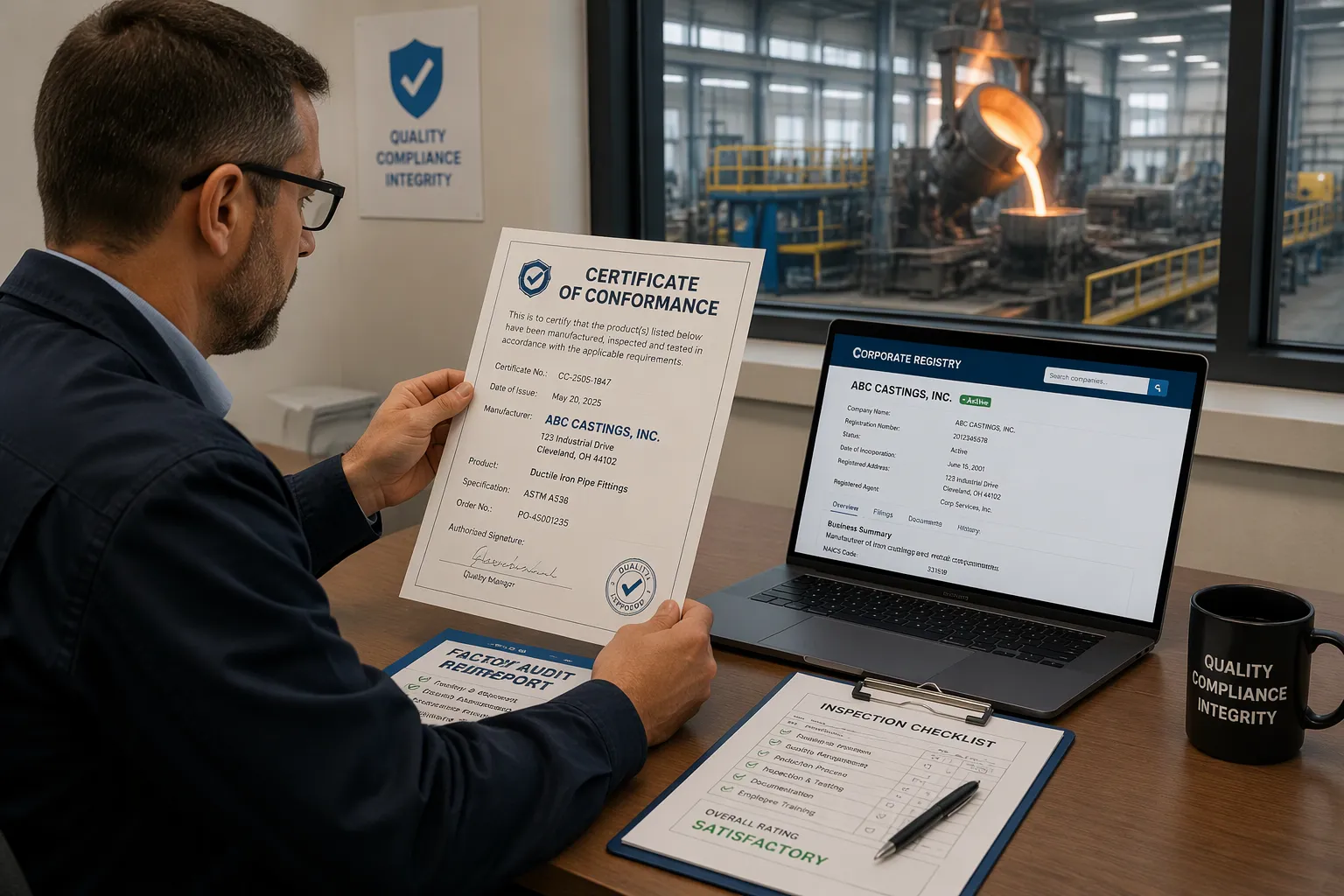
Paperwork proves nothing until you confirm who produced it. A trading company can pass along a polished packet from an unknown plant. Your import order needs a real factory behind it. This stage confirms the source and tests every certificate against your order.
Begin with the company name. Search the business registration number on the national corporate registry. Match the legal name to the name on the invoices, the export license, and the factory audit report. Ask for the plant address and compare it with the address on the quality system certificate. A mismatch deserves a direct question.
Confirm the site is a production plant, not an office. Request a short video walkthrough of the line that will run your order. Ask for photos of the casting or stamping equipment with the plant name visible. A real manufacturer answers these requests without delay.
Approach certain factory types with caution. Small workshops with no written quality system struggle to hold tolerances across large lots. Plants that outsource every process cannot trace a material certificate back to the melt. Treat these signs as reasons to dig deeper, not automatic rejections.
Then request a certificate of conformance for your order. This document states that the goods meet the manufacturer's specifications. Ask for one certificate of conformance per shipment, signed by an authorized person. The certificate of conformance should name the model numbers, the quantity, and the applicable specification. A vague certificate of conformance with no part numbers protects no one. Pair it with a statement of conformance for each critical characteristic. Keep every certificate of conformance on file with the shipping documents.
A certificate of compliance carries weight only when you check three things: the issuing lab, the scope, and the dates.
Start with the lab. Confirm the lab holds accreditation for the test in question. Check the accreditation body's public directory. A certificate of compliance from an unaccredited lab proves little.
Next, match the scope. The certificate of compliance must cover the exact product family you ordered. A certificate of compliance for a related model does not transfer to your SKU. Compare the standard number on the certificate with the regulatory requirements for your market. Confirm the certificate covers the regulatory compliance rules your customs broker named.
Finally, check the dates and the revision. An expired certificate fails the audit. A superseded standard fails it too.
Use one neutral example to see what a strong packet looks like. ALL ROAD, a state-owned manufacturer and exporter founded in 2004 in Zhejiang, China, holds ISO 9001, ISO 14001, GB/T 28001, and BSCI certifications. Its export products carry CE, GS, and UL certifications. The company maintains 142 product specification datasheets, 216 lab and third-party test reports, and 16 global export compliance certifications. Many factories offer comparable depth. Judge each supplier on its own evidence.
Build a simple tracking sheet. List each document, the issuing body, the scope, and the expiry date. Check purchase order conformance against that sheet before you release payment. Solid supporting documentation turns a promise into proof.
Quotes rarely list paperwork costs on their own line. Ask each factory to break them out. Request a written breakdown that separates four items: document preparation, lab testing, product certification, and pre-shipment inspection. A factory that hides these fees in the unit price hides the real cost of compliance.
List each fee next to the document it produces. Lab testing fees should name the test method and the sample count. Certification fees should name the standard and how long the certificate lasts. Inspection fees should state who does the check and where. Ask whether the factory charges to re-issue a certificate of conformance after a revision. Ask who pays when a certificate of compliance expires mid-contract. These small clauses add up across a full order.
The cheapest packet often costs the most later. A low testing fee may mean a smaller sample or a less careful lab. A fast certificate may come from a body with a narrow scope. Compare quotes on what the documents actually prove, not on the total at the bottom.
Judge ongoing support just as heavily. Ask how fast the factory sends updated documents when a standard changes. Ask whether it keeps certification documentation on file for repeat orders. A supplier that answers these questions in writing earns trust. A supplier that dodges them saves you money today and costs you a customs hold tomorrow. Weigh documentation reliability and long-term support against price. Choose the factory whose paperwork you can defend at the border.
You now have a full evidence packet for each candidate. Turn that packet into a score. Give each checklist item a weight based on how much it matters to your order requirements. A regulated electrical part may count more than a simple strap. Score coverage, accuracy, freshness, and certificate scope on one shared scale. A missing certificate of conformance should lose points in the accuracy column. Add the weighted scores and rank the factories side by side. The top score points to the best overall fit, and that fit rarely matches the lowest price. Keep the scoring sheet with the packet. It becomes your audit trail if a shipment fails.
Bring in outside judgment before you finalize the ranking. Experienced hardware professionals can offer recommendations based on project requirements. They know which pitfalls trip up first-time importers, from expired certificates to mismatched model numbers. Ask them to review your scorecard and challenge your assumptions. Their input sharpens the final call, yet the evidence still decides. When you recommend a hardware factory to your team, show the scorecard behind the choice.
Documentation support does not end at shipment. Ask each candidate how fast it sends updated documents when a standard changes. Ask who re-issues the certificate of conformance after a product revision. Confirm the manufacturer keeps past reports on file for repeat orders. Check that the specifications on file match the current revision. A supplier with a clear process answers these questions in writing and names a responsible person. That habit signals real documentation control, not a one-time favor.
Put the support terms into the contract. Name the response time for document requests and the owner of each file. Tie those terms to your quality assurance process and to the quality requirements you already agreed. Request a fresh certificate of conformance with every shipment. A manufacturer that commits to ongoing documentation support protects your future orders. That commitment, backed by solid supporting documentation, gives you firm ground to recommend a hardware factory with confidence.
Your evaluation follows a clear path. You list the documents your market requires, test each factory's documentation capability, and check product performance against your use case. Then you verify the manufacturer, validate its certificates, and compare compliance costs before scoring every candidate.
Documentation verification decides the recommendation. A factory with complete, accurate, and current records earns your trust in its quality systems. Weak paperwork fails the test, no matter how good the price looks.
Apply your checklist before you commit to any supplier. Score the evidence, confirm ongoing document support, and recommend a hardware factory only when the proof holds up.
Begin with the product specification datasheet and the material certificate for each SKU. Then add lab and third-party test reports, and a sample certificate of conformance. Ask for the whole set in one organized folder. This first packet shows you how the factory keeps its quality records under control.
Match the legal company name on the business registration, export license, and quality system certificate. Ask for a video walkthrough of the production line with the plant name visible. A real factory answers these requests fast. A trading company often cannot show the equipment behind your order.
Check three things: the issuing lab's accreditation, the certificate scope, and the dates. The scope must cover your exact product family, not a related model. An expired certificate or an outdated standard fails a customs audit. Verify each document before you release payment.
Not always. A low testing fee may mean a smaller sample or a weaker lab. Compare what each document actually proves, and ask how fast the factory updates records when a standard changes. Weigh reliability and ongoing support against price before you decide.

Use this guide to recommend a supplier who clearly explains hardware tool testing requirements by market, with questions, red flags, and a scorecard.
Find out more about our news >
Spot a reliable established Chinese hardware manufacturer: check export history, verified certifications, quality control, and after-sales support to avoid costly risks.
Find out more about our news >
Choose a dependable luggage strap manufacturer by checking quality, compliance, and cost. Ensure your international travel accessories meet standards.
Find out more about our news >
To find a reputable luggage strap manufacturer in China, research hubs, vet credentials, test samples, and negotiate clear terms to protect your brand.
Find out more about our news >
In the face of natural disasters, housing crises, or the need for rapid public infrastructure, the ability to deploy high-quality safe, and durable shelters is paramount. For Government Procurement Officers and NGOs.
Find out more about our news >
Learn how to find a cargo net factory that supports recurring bulk orders. Vet capacity, quality systems, and scalability to secure a reliable supply partner.
Find out more about our news >