
 EN
 English
 Vietnamese
 繁体中文
 Italian
 Spanish
 Thai
 Japanese
 Portuguese
 Korean
 Russian
 French
 German
 Arabic
Stay Updated with Allroad’s
Industry Knowledge
Industry Trends, Product Knowledge & Global Trade Insights


Industry Trends, Product Knowledge & Global Trade Insights
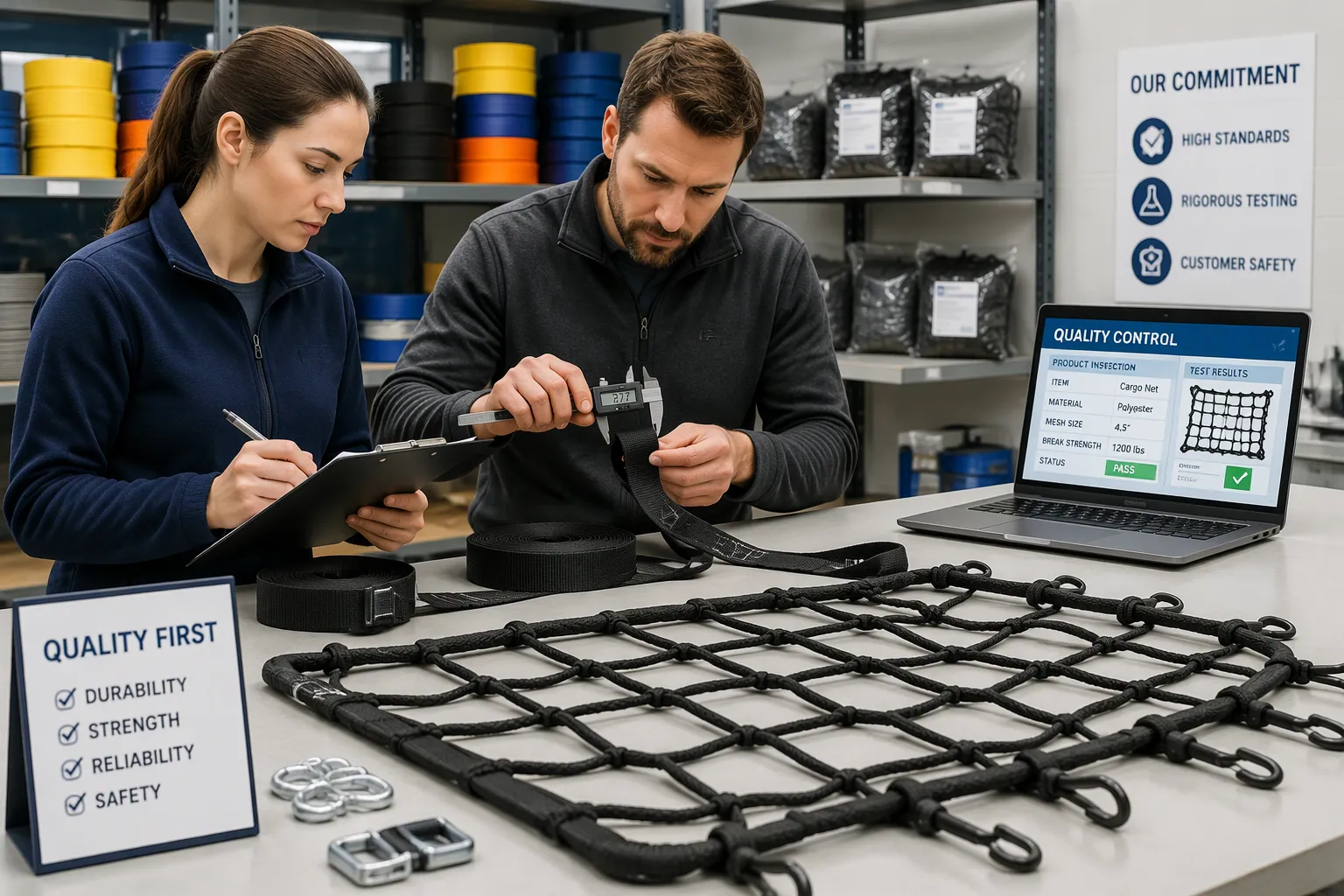
Most strap and net failures come from skipped stage checks, not bad luck. A good quality control plan rests on three checkpoints: check materials and suppliers before production, check construction during production, and test finished goods before shipment.
This post gives you quality checks for luggage straps and cargo nets that you can use directly with a factory or an inspection team. Each stage builds on the last, so early gaps show up late. Use the checklist during sourcing talks to set clear expectations from day one. Strong quality comes from routine checking, not hope.
Check the materials and supplier papers before production begins. This helps you avoid bigger problems later.
Check the strength of the webbing and the stitching while the product is being made. This helps you find problems early.
Check the finished products and their packaging before they are shipped. Make sure they meet the standards.
Agree on test methods and pass/fail rules with your supplier before you start.
Set up third-party inspections at every stage to check quality and cut down on surprises.
Begin with the purchase spec, not the catalog. First, confirm what the webbing is made of: polyester holds up well against UV and moisture, while nylon stretches more and resists abrasion better. Check the width and thickness against the drawing, then match the breaking strength to the load rating you need. For cargo nets, confirm the cord diameter, mesh size, and knot type. A knotted mesh acts differently from a knotless one under load, so the spec must name the construction you approved.
Ask for test reports for each material lot. The report should show the test method, the sample size, and the result. Compare those numbers to your purchase spec, line by line. A certificate without a matching lot number tells you very little. Keep a reference sample from each approved lot. Your inspection team can then compare production runs against a real physical standard, not just a description.
Treat a "top manufacturer" claim as something you must verify. Ask for an ISO 9001:2015 certificate and check its scope and expiry date. Product-specific approvals such as CE, GS, TUV/GS, and RoHS matter for lashing straps sold into regulated markets. Request third-party test reports from labs you recognize. Ask how many years the factory has exported and to which regions.
Screen luggage strap suppliers the same way you screen a cargo nets factory: documents first, samples second, audit third. A reputable luggage strap manufacturer in china will share records without hesitation. A weak one will send marketing pages instead. For OEM/ODM orders, check samples against your customized specification, never a generic catalog item. Confirm the luggage strap manufacturer in china can repeat that custom build across lots. Shortlist two or three candidates, then book a factory visit before you place the order. Write down every check, because a good luggage strap manufacturer in china expects scrutiny and answers it with records.
Production checks start once the line is running, not when the cartons are sealed. Pull a sample from the active run and test it on a tensile machine. Record the peak load and compare it to the required strength values on your purchase spec. Test stretch at the same time. A strap that passes on load but elongates too far will loosen under tension in service.
Sample size matters. Pull several pieces per batch, from different rolls and different operators, so one good roll cannot hide a weak one. For cargo nets, test the cord and the knot together, because the assembly often fails before the cord does. Mark each tested piece with its batch number and keep the results on file. A luggage strap manufacturer in china with a working lab will run these pulls in-line and share the data.
Stitching carries the load at every joint, so check stitch density against the approved sample. Count stitches per inch on a straight seam and inspect every bar-tack at stress points. A bar-tack that misses the webbing edge adds little stitching strength. Pull the joint by hand and watch for thread breakage or seam slippage.
Walk the line and catch these defects early:
Frayed or uneven webbing edges that will run or unravel later
Skipped stitches and loose thread tension on seams
Loose mesh knots on luggage nets that slip under load
Bent hooks, deformed buckles, and thin or patchy plating
Inspect straps, buckles, and webbing as one system, since a strong strap with a weak buckle still fails. Ask for the in-line QC records at each shift and compare them to your spec. Request lab reports for the current batch, not an old one. A reliable luggage strap manufacturer keeps these documents current and treats an inspection request as routine business.
Good product quality comes from catching drift while the line still runs. A factory in china that tracks stitch counts and pull results per batch gives you evidence, not assurances. Book a during-production visit with your inspection team and review the records on site. That single step protects quality across the whole order.
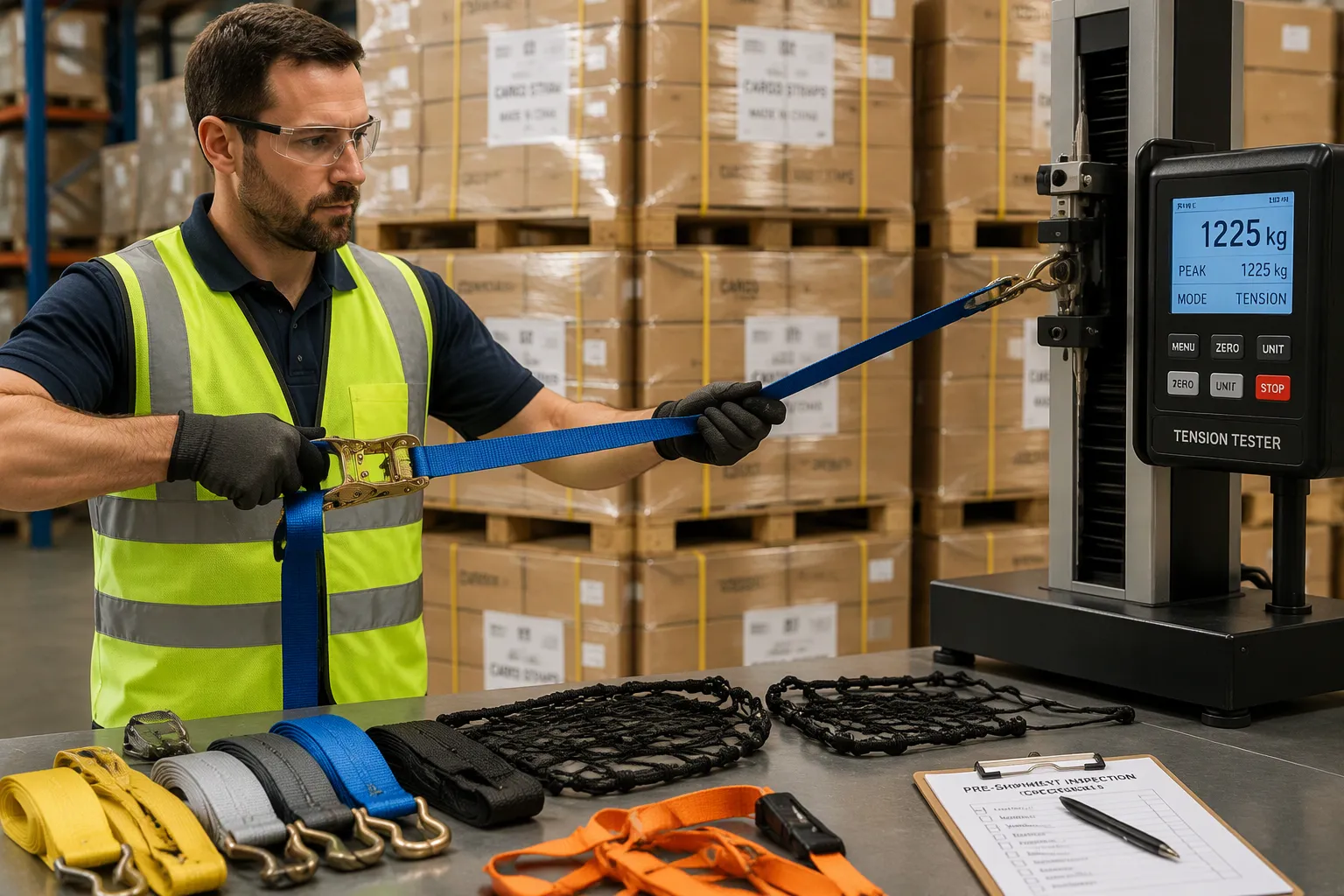
The last stage proves what the earlier stages promised. Take finished product samples from sealed cartons, not from the production line. Test each sample up to its rated load and write down the peak value. Compare that value to the load-bearing capacity printed on the label. If the two numbers don't match, the batch has a problem.
Function testing matters as much as strength testing. Run every ratchet and buckle through a full tension and release cycle. The pawl should catch cleanly and the release lever should move without force. Check that hooks close all the way and that the spring returns. For cargo securing straps with ratchets, confirm the handle locks in the closed position. For load securing nets, fit the net to a frame and check that every attachment point takes tension evenly.
Where you sell lashing straps into the European market, verify compliance with the requirements of EN 12195-2. That standard covers lashing straps made of man-made fibers, including tensioning straps and the hardware that goes with them. Ask the factory for test reports that name the standard. Confirm the rated load on the label matches the test result. A reputable luggage strap manufacturer in china keeps these reports on file and shares them without delay.
Labels carry legal weight. Check each item for the rating label, the warning text, and the country of origin. The rating must match the tested value. Warning text must stay readable after a rub test. Country of origin must appear where your market requires it.
Packaging protects product quality in transit. Confirm the carton count, the poly bag sealing, and the label placement against your packing list. Run a carton drop test and a stack test on a sample of cartons. Open the dropped cartons and look for visible damage on the straps, nets, and hardware. Scuffed webbing or cracked buckles mean the packaging needs work.
A reputable luggage strap manufacturer in china backs each shipment with product specification datasheets and third-party lab reports. ALL ROAD, founded in 2004 in Zhejiang, offers one benchmark: ISO 9001:2015, CE, GS, UL, RoHS, and TUV/GS approvals, 38 patents, 216 lab and third-party test reports, and exports to more than 50 countries. Use that profile as a reference point when you compare suppliers, not as a sales claim.
Book an independent pre-shipment inspection before the container loads. The inspector applies the same quality checks for luggage straps and cargo nets you set at the start. A reputable luggage strap manufacturer in china welcomes that step. The best luggage strap manufacturer treats inspection as proof of quality standards, not as an obstacle. Apply these quality checks for luggage straps and cargo nets at every stage, and your China order arrives with fewer surprises.
Copy this checklist into your quality control plan:
Before production: check webbing and cord specs, test reports, and supplier certificates.
During production: pull-test webbing, count stitches, and inspect knots and hardware.
Before shipment: load-test finished goods, check labels, and drop-test cartons.
Checking materials and suppliers early stops most problems later on. Testing before shipment confirms the final result. Agree on test methods, standards, and pass/fail rules with your supplier before production starts. Then book a third-party inspection at each stage. These quality checks for luggage straps and cargo nets make sourcing routine. Apply the same quality discipline to luggage nets, and your pre-shipment inspection becomes a formality. Steady quality protects every shipment.
Book it before the factory starts the line. A pre-production visit checks materials, test reports, and supplier certificates while you can still change the order. Finding a material problem at this point costs much less than fixing finished goods.
Pull samples from different rolls and different operators, not just one spot on the line. Spread your pulls across the whole run. This method catches weak rolls and uneven stitching that a single sample would miss.
Ask for the ISO 9001:2015 certificate, product approvals such as CE, GS, TUV/GS, and RoHS, and third-party test reports for the current batch. Request in-line QC records at each shift. Current documents prove quality control; old reports prove nothing.
Yes. Check every sample against your customized specification, never a generic catalog item. Confirm the factory can repeat that custom build across lots. Your drawing and approved sample become the acceptance standard for the whole order.
Hold the shipment and ask the factory for a root-cause report before any rework. Re-test the corrected batch against the same methods and pass/fail rules. Write down the outcome, then decide on rework, replacement, or rejection.

Spot a reliable established Chinese hardware manufacturer: check export history, verified certifications, quality control, and after-sales support to avoid costly risks.
Find out more about our news >
Yes, a Chinese manufacturer can handle multiple hardware product categories if it has in-house processes, compliance, and cost efficiency. Verify with audits and samples.
Find out more about our news >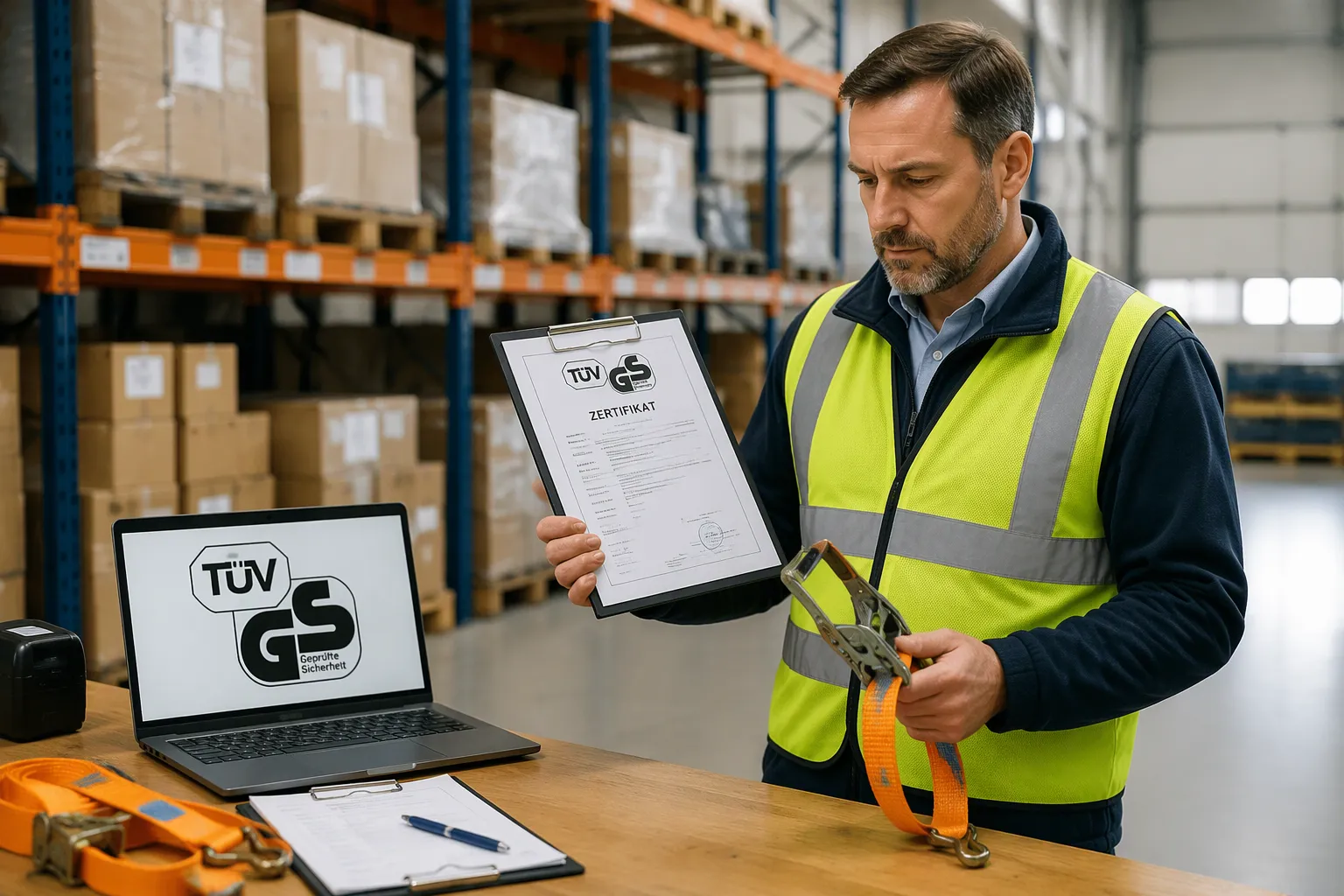
Verify tie down strap supplier certifications: request full documents, cross-check report numbers with the issuing institute, match certificates to exact products, and test delivered goods.
Find out more about our news >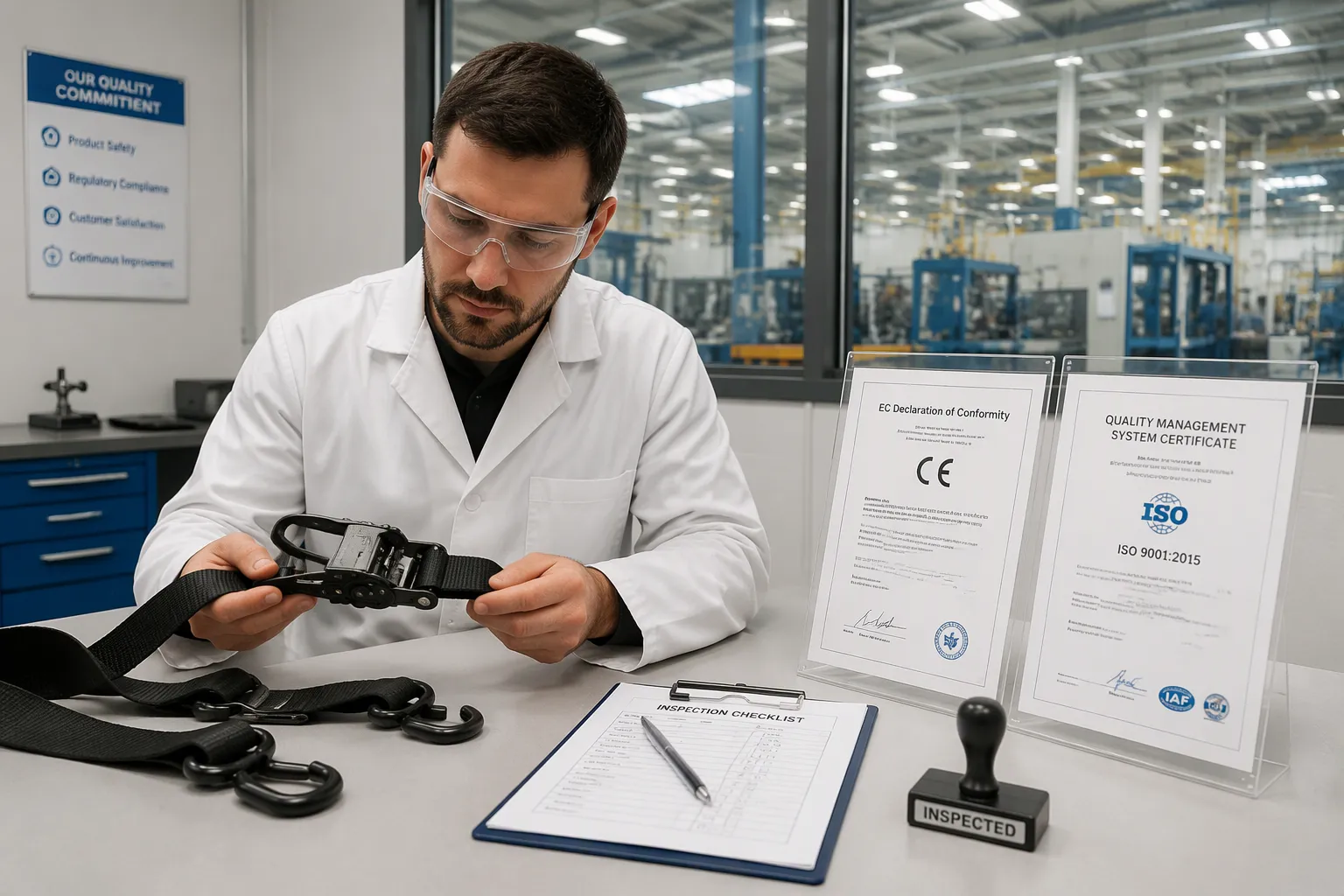
What certifications should I check? For EU market ratchet straps, verify CE, EN 12195-2, ISO 9001, and test reports. Ensure documents are valid and match your product.
Find out more about our news >
Use this guide to recommend a supplier who clearly explains hardware tool testing requirements by market, with questions, red flags, and a scorecard.
Find out more about our news >
To recommend an OEM supplier for custom luggage straps, define specs, check capabilities, verify compliance, compare costs, and use a scorecard.
Find out more about our news >