
 EN
 English
 Vietnamese
 繁体中文
 Italian
 Spanish
 Thai
 Japanese
 Portuguese
 Korean
 Russian
 French
 German
 Arabic
Stay Updated with Allroad’s
Industry Knowledge
Industry Trends, Product Knowledge & Global Trade Insights

Industry Trends, Product Knowledge & Global Trade Insights
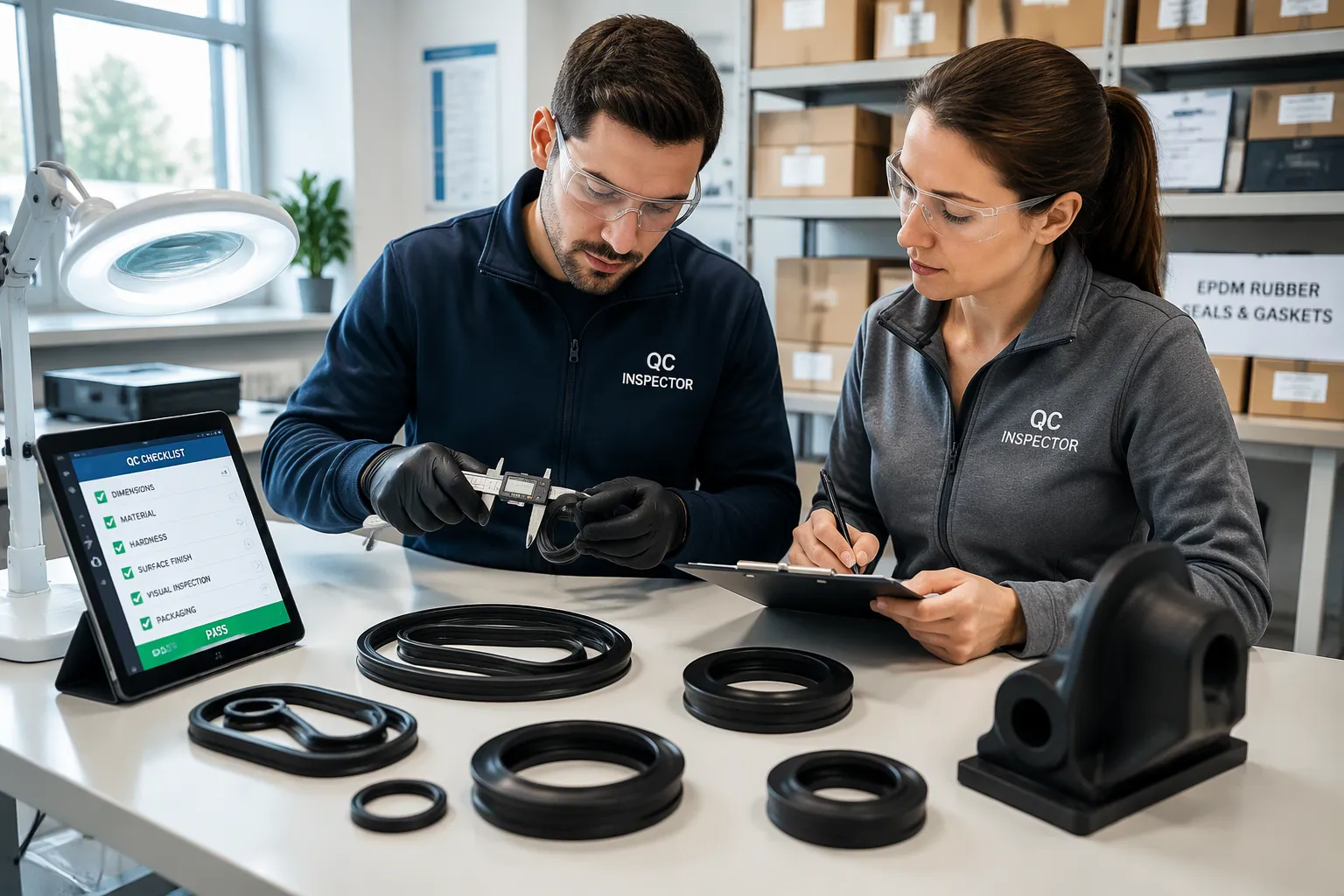
The most important check comes first: make sure the factory can really make EPDM accessories to your specifications. A quote by itself proves nothing.
These accessories are easy to fake. Suppliers may swap in cheaper compounds, cure parts unevenly, or act as trading companies pretending to be factories. These problems show up after delivery, when cost, timeline, and brand reputation suffer. You need to verify before purchasing EPDM rubber accessories, not after.
Use the checklist below as a practical, step-by-step order for China sourcing. Apply each step right away, from compound checks to compliance documents. Treat every item as a quality gate, and demand written proof of quality. This discipline applies to seals, hoses, or rubber coated balls.
Check that the factory's business license and scope include rubber manufacturing.
Check that the EPDM compound grade fits what you need for your application.
Check production quality using PPAP, MES traceability, and a lab inside the factory.
Check compliance papers like RoHS and REACH, and make sure the certificate numbers can be traced.
Check samples from every batch, and agree on clear payment terms before you pay a deposit.
Start with the business license. Every registered company in China has one, and you can ask for a copy before you talk about price. Read three fields with care: the registered company name, the registered capital, and the business scope. The business scope lists the activities the company is legally allowed to do. Check that it clearly covers rubber products, EPDM molding, or rubber accessory manufacturing. If the scope only lists trade, consulting, or "import and export," the company may not make anything itself. Match the company name on the license to the name on the quote and the bank account. Any mismatch here is an early warning sign. Cross-check the license against the National Enterprise Credit Information Publicity System, the official registry you can search online. Confirm the company is active, not revoked or marked abnormal. This step takes only minutes and filters out weak candidates before you spend more time.
A trading company can quote any product. A factory must prove it can make yours. Ask for evidence in layers. Request a production video that shows the mixing, molding, and curing stages for EPDM parts, not a generic showroom tour. Ask for an equipment list with machine models and capacities. A real manufacturer names its internal mixers, compression or injection presses, and curing ovens without hesitation. Then verify. A factory visit gives you the strongest proof, because you see raw compound, work-in-progress, and finished goods in one place. If you cannot travel, hire a third-party audit. An auditor checks production floors, warehouse stock, and staff roles for you.
Supplier qualification, audits, and factory visits remain the safest path to sourcing directly from Chinese manufacturers. Treat them as a sequence, not alternatives. The license check qualifies the company. The audit or visit confirms the factory. Only then should you discuss compound grades and pricing. This order protects you from paying factory prices to a middleman. It also matters for technical products. A rubber coated ball supplier that truly molds its own parts can control hardness and cure. A trader cannot. The same logic applies to rubber coated balls, seals, and custom EPDM profiles. When you verify before purchasing EPDM rubber accessories, you confirm the production floor exists, not just the sales office. Strong suppliers welcome this scrutiny. Weak ones resist it, and that resistance is your answer.
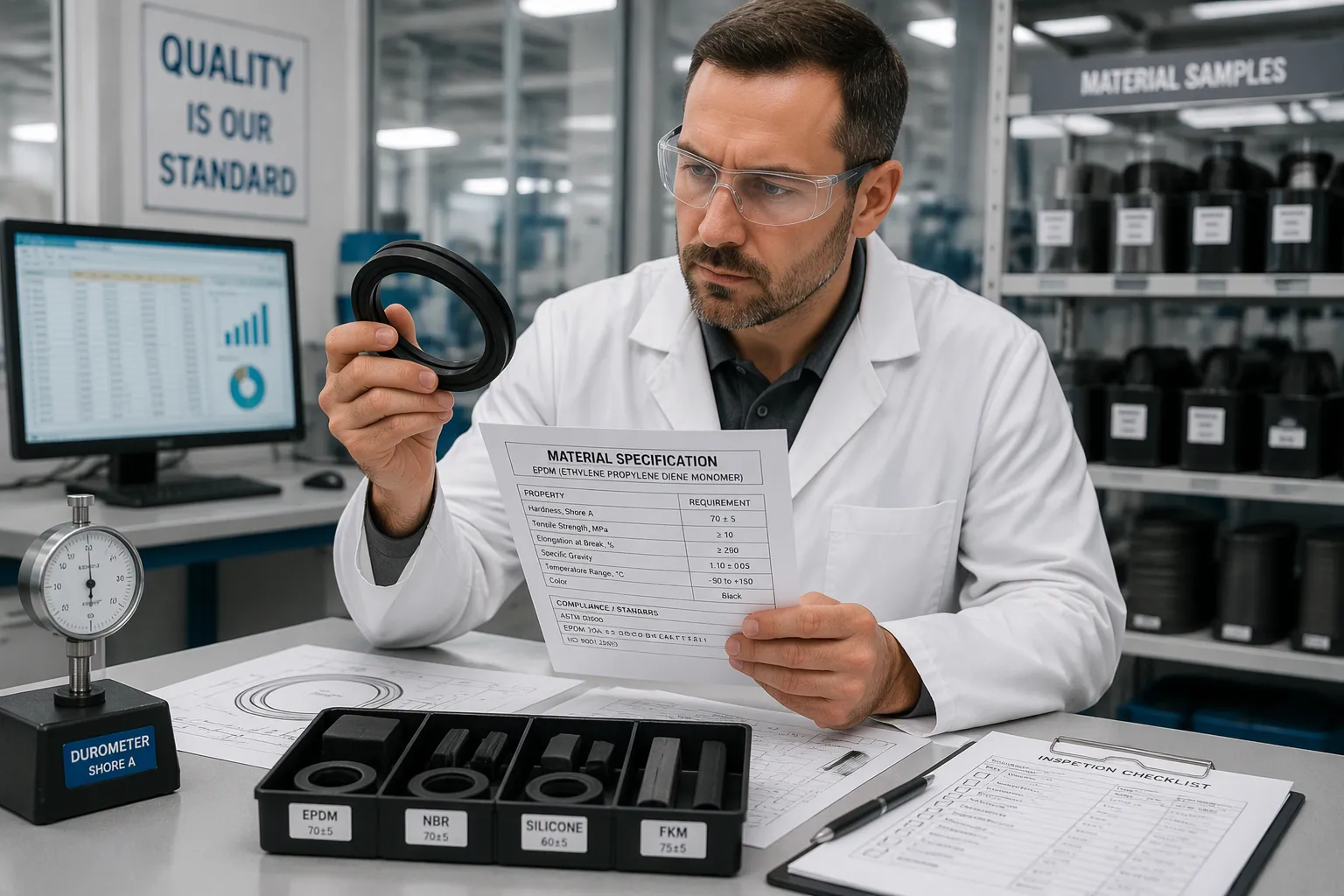
A price quote tells you nothing about the compound inside the part. Before you approve any order, you must match the EPDM grade to what your application needs. Start with four parameters: hardness, temperature range, ozone and UV resistance, and compression set. Each one connects to how the part works in service.
Parameter | What to confirm | Why it matters |
|---|---|---|
Hardness | Target durometer and tolerance | Sealing force and fit |
Temperature range | Continuous and peak service limits | Part life under heat or cold |
Ozone and UV resistance | Compound grade and test method | Cracking outdoors |
Compression set | Test method and result | Seal recovery over time |
Ask the factory for detailed material specifications on the exact compound code they will run. A general "EPDM 70 Shore A" line is not enough. You need the full material specification sheet: base polymer, filler loading, cure system, and test values. Compare material data sheets across two or three suppliers. The rubber type must match the environment where you use it. A part exposed to oil, steam, or strong chemicals may need a different rubber type entirely. That is because standard EPDM resists water, weather, and polar media but swells in hydrocarbon oils. List the media that touch the part and send that list to the factory in writing. The media in contact often decide material choice more than any other factor. This step also applies to rubber coated ball products, where the EPDM coating must survive the same conditions as a molded seal.
Substitution is the most common quality failure in EPDM sourcing from China. A supplier may quote EPDM and then mold the part in a cheaper rubber, such as SBR or reclaimed rubber. The part looks the same when it arrives. It fails months later in the field. Excess filler creates a second risk. Heavy filler loading lowers cost and also lowers elasticity, tear strength, and aging performance.
Treat any compound change without your written approval as a quality control failure, not a cost saving.
Detect both problems with documents and lab tests. Request the compound datasheet and check the polymer base, filler type, and filler loading. Then verify with testing. Infrared spectroscopy identifies the polymer family. Thermogravimetric analysis measures filler content. Ozone aging and heat aging tests reveal weak compounds fast. Apply the same checks to rubber coated balls and epdm-coated balls, where a thin epdm coating hides the core compound. A supplier with real quality control will share test reports without pressure. Run these tests before you scale any order.
A quality management system shows how a factory controls its processes. Ask for the certificate and make sure its scope covers rubber molding. IATF 16949 is the automotive standard and shows strong process discipline. ISO9001 works as a basic level for general manufacturing. Then check PPAP capability. PPAP, or Production Part Approval Process, proves the factory can meet your specifications before mass production. Ask for the PPAP file: dimensional results, material test reports, and process flow diagrams. A factory with real quality control shares these documents without delay. Quality control at this stage separates serious factories from casual traders.
Production control processes matter too. Ask how the factory handles incoming material inspection, in-process checks, and final inspection. Look for written procedures and records from recent orders. A supplier that tracks quality at each stage reduces batch-to-batch variation. This discipline protects your order from surprises. Strong quality control here means fewer rejects and steadier output.
MES, or Manufacturing Execution System, tracks materials and batches through production. Ask the factory to show how the system links raw compound lots to finished parts. Strong traceability lets you trace a defect back to a specific batch and material lot. This control and traceability protects you during recalls or field failures. Confirm the factory runs an in-house laboratory for testing EPDM parts. An in-house lab speeds up quality checks and reduces reliance on outside services. It also supports routine tests on every batch.
ALL ROAD shows what strong documentation looks like. The company holds ISO9001, ISO14001, and GB/T28001 certifications. It maintains 216 lab and third-party test reports. Its in-house R&D and OEM capability support custom EPDM parts, rubber coated ball products, and rubber coated balls with consistent quality. A rubber coated ball from this factory meets the same quality standards as a molded seal. This level of documentation supports supplier evaluation and material consistency across orders. For rubber coated balls, the epdm coating must meet the same quality standards as molded parts. Rubber coated balls with a weak coating fail early in the field. A factory with a real lab and traceability system gives you confidence in every shipment. Buyers in China and worldwide rely on this kind of quality proof.
Compliance papers show that your goods can legally enter the United States. Ask for the full set of documents before you pay a deposit. For EPDM accessories, you need RoHS and REACH declarations, material safety data sheets, and test reports from an accredited lab. The table below shows what each document covers.
Document | What it proves |
|---|---|
RoHS declaration | Restricted substances stay below legal limits |
REACH statement | Chemical registration and safety compliance |
Material safety data sheet | Safe handling and storage information |
Lab test report | Independent test results on the actual compound |
Fake certificates are common when sourcing from China. Check every document. Look up the certificate number on the issuing body's website. Make sure the lab is accredited. Match the part number and compound code on the report to your order. A certificate with no traceable number should not be trusted. Strong suppliers share these documents without pressure.
You, the importer, hold the legal duty for compliance. The factory can supply documents, but the responsibility stays with you. Confirm your EPDM parts meet applicable product certification and consumer safety requirements. Classify each product under the correct HS code. A wrong code causes delays, fines, or refused entry at customs.
Document every compliance confirmation in writing before shipment.
ALL ROAD shows what a well-documented supplier looks like. The company holds TUV/GS, CE, UL, and RoHS approvals. It also keeps 16 global export compliance certifications. This paperwork supports smooth customs clearance and protects your brand. Apply the same quality checks to rubber coated ball products and rubber coated balls. The coating must meet the same compliance standards as molded EPDM parts. Request test reports for every batch. Consistent quality control here prevents costly rejections. Reliable suppliers treat compliance as routine, not extra work.
Ask for molded samples taken from the real production run, not a special hand-built sample. Test at least three parts from each cavity and each batch. Small orders need the same careful checks as large ones. Ask for size checks, hardness, tensile strength, and aging tests. Add ozone testing for parts used outdoors. A rubber coated ball also needs a coating adhesion check. Rubber coated balls with a loose coating fail early, so test the bond, not just the surface.
Run your own tests on the samples you receive. Use a third-party lab when the order value is high, when the part is safety-related, or when the supplier's reports look inconsistent. Independent results give you a clean baseline for supplier evaluation. Keep every report on file. These tests protect your quality standard before mass production starts.
Ask for a full quotation breakdown before you discuss a deposit. The quote should list material, molding, tooling, testing, packaging, and freight as separate items. A single lump price hides cost shifts later. Typical terms start with a deposit and balance against shipping documents. Negotiate milestones that match production stages.
Confirm after-sales support in writing. Ask for the warranty period, the replacement policy for defective batches, and the documents you will receive with each shipment. Clarify who pays for return freight on rejects. A supplier in China that answers these questions clearly shows real quality control discipline. Apply the same terms to rubber coated balls and epdm parts. Write down every confirmation, then pay your deposit.
Five checks protect your order. First, confirm the factory can really make EPDM parts. Second, check that the compound quality fits your application. Third, make sure production is controlled and traceable. Fourth, get real compliance documents and test reports. Fifth, agree on clear business terms. Do these checks in order, not as random questions. Each step builds on the one before, from the business license to the lab report.
Use the same quality care for every item from China, including a rubber coated ball or a batch of rubber coated balls. A rubber coated ball hides the compound inside, so quality checks matter even more. Verify before purchasing EPDM rubber accessories now, and verify again on every reorder. Write down each quality confirmation before you pay a deposit.
Ask for a production video that shows mixing, molding, and curing. Request an equipment list with machine models. Then visit the factory or hire a third-party audit. A real manufacturer welcomes this scrutiny. A trading company resists it. This check protects your quality standard before you pay anything.
Request the full material specification sheet: base polymer, filler loading, cure system, and test values. Add infrared spectroscopy and thermogravimetric analysis results. A rubber coated ball hides its core, so demand lab reports on the actual compound. Weak suppliers avoid these requests. Strong ones share them freely.
Check ISO9001 or IATF 16949 for quality management. Confirm RoHS and REACH declarations with traceable certificate numbers. Look up each number on the issuing body's website. Match part numbers to your order. Reliable suppliers treat compliance as routine. Fake papers fail this check fast.
Test at least three parts from each cavity and batch. Request dimensional checks, hardness, tensile strength, and aging tests. Add ozone testing for outdoor use. For a rubber coated ball, test coating adhesion too. Use a third-party lab for safety-related parts. Keep every report on file.
Ask for a full quotation breakdown: material, molding, tooling, testing, packaging, and freight. Pay a deposit, then balance against shipping documents. Confirm the warranty period and replacement policy in writing. Clarify who pays return freight on rejects. Document every confirmation before you commit.
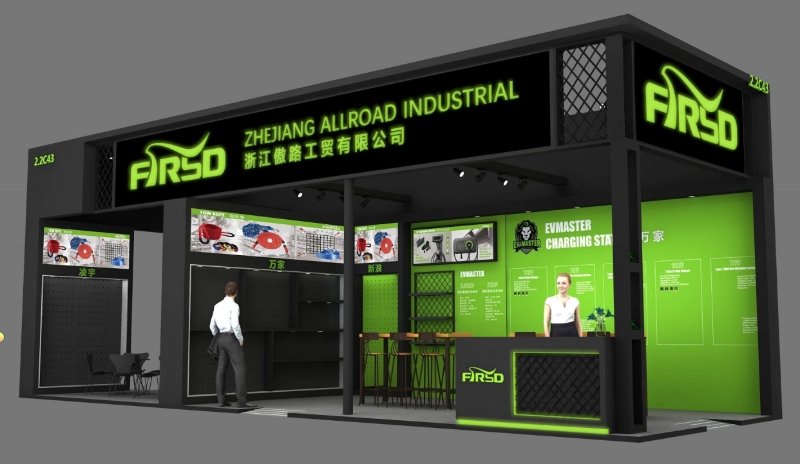
Meet ALL ROAD at Automechanika Shanghai 2026, December 2–5, at Booth 2.2C43. Explore automotive emergency products, EV chargers and OEM/ODM solutions for global buyers.
Find out more about our news >
Identify a reliable factory that manufactures tow ropes and cargo straps by defining specs, using targeted channels, auditing suppliers, comparing quotes, and trial orders.
Find out more about our news >
For 2026, choose a specialized mid-to-large Chinese manufacturer for OEM ratchet tie down straps with in-house webbing and certified assembly for safety and compliance.
Find out more about our news >
To recommend an OEM supplier for custom luggage straps, define specs, check capabilities, verify compliance, compare costs, and use a scorecard.
Find out more about our news >
Ensure your import business thrives by checking these 5 critical factors in a dependable supplier of hardware tools, from quality to communication.
Find out more about our news >
Ask manufacturers for written QC manuals, IATF 16949 certificates, PPAP packages, and test reports to verify documented quality control procedures.
Find out more about our news >