
 EN
 English
 Vietnamese
 繁体中文
 Italian
 Spanish
 Thai
 Japanese
 Portuguese
 Korean
 Russian
 French
 German
 Arabic
Stay Updated with Allroad’s
Industry Knowledge
Industry Trends, Product Knowledge & Global Trade Insights

Industry Trends, Product Knowledge & Global Trade Insights

You assess manufacturing capabilities by stating your needs, doing a desk review, running a factory audit, checking technical skills, checking financial and supply chain stability, comparing suppliers fairly, and confirming everything with a trial order. Each step removes a specific risk before you commit large sums at scale.
State specifications and order volume
Review certifications and legal records
Audit the factory for capacity and quality control
Test samples and judge engineering support
Check financial health and material sources
Score suppliers on verified evidence
Pass a trial order before the full run
This guide gives you a step-by-step, verifiable process you can use right away to assess manufacturing capabilities.
Write clear specifications and order volumes to set a standard for suppliers.
Check certificates and legal records to make sure the supplier is legitimate.
Do a factory audit to check capacity and quality control systems.
Check sample products and look at the company's finances. This helps you judge their technical skills and how well their supply chain works.
Rate suppliers based on proof, and place a small test order before you commit to a big one.
Begin with a written spec sheet. List every material, dimension, and tolerance that matters. Add performance targets, packaging requirements, and your target order volume. This document becomes the benchmark for every supplier you contact. A vague brief invites vague quotes. You cannot assess manufacturing capabilities against a target that keeps moving.
Be precise about tolerances and test methods. State how you will measure each critical feature. Include the units and the acceptance range. If a supplier cannot quote against your spec sheet, that tells you something useful early.
Ask each candidate whether it runs a real manufacturing facility or sources from others. A trading company may still serve you well. But you cannot audit production lines it does not own. Request the business license and check the registered scope. Visit the site or commission a third-party audit to confirm the chinese factory exists and operates.
Check the minimum order quantity against your volume. Ask about production flexibility for changeovers and rush orders. Confirm quoted lead times with a simple test: request the production schedule for a similar past order. Realistic lead times account for material procurement, not just assembly time.
Build your shortlist from verifiable sources. Look at years in operation, export records, and named references you can contact. Many contract manufacturers in china publish client lists that you can cross-check. Treat every claim as a lead to verify, not a fact to accept.
Ask for the certificate itself, not just a logo on a website. Request ISO 9001 for quality management. Add industry-specific programs where they apply, such as IATF 16949 for automotive work. Then confirm the certificate number with the issuing body. A valid certificate names your supplier, a scope that covers your product, and an expiry date in the future.
Product-level approvals need the same treatment. Collect CE, GS, UL, or similar marks and match each one to the exact model you plan to buy. Check global export compliance documents too. A certificate for a different product line tells you nothing about your order.
Pull the business license and compare the registered name, scope, and address against the quote and the certificate holder. Mismatches deserve an explanation before you proceed. This step sits at the heart of supplier verification for oem manufacturing in china, because paperwork is cheap to present and slow to disprove.
A supplier may present credentials such as ISO 9001, ISO 14001, CE/GS/UL product approvals, patent counts, lab and third-party test reports, and export compliance certificates. Treat each as a document to verify, not a claim to accept. Contact the issuing body, check the scope, and confirm the model.
Certification review is a desk step. It does not replace an on-site factory audit.
Use this desk work to filter chinese suppliers before you spend money on travel. Strong paperwork shortens the later factory audits, and weak paperwork saves you a trip. Either way, you learn where a chinese supplier stands before samples ship.

Plan the factory audit before you book the flight. Send the supplier your spec sheet and order volume. Ask for a production schedule and a list of machines tied to your product. Then walk the floor and check each claim against what you see.
Count the production lines and note the equipment on each one. Ask how many hours per day the lines run and how many days per week. Compare the quoted production capacity with the real capacity available. A supplier may quote a number that assumes full use. Your order needs room in a schedule that already serves other clients.
Check warehouse and inventory management too. Look at how the chinese factory stores raw materials and finished goods. Ask how it tracks stock and how it handles old inventory. A facility that matches that claim will show organized storage, labeled bins, and a stock system that works.
Trace the quality control systems from incoming material to final shipment. Start at the receiving dock. Ask how the supplier inspects incoming materials and what it rejects. Move to the line and review inspection during production. Note the checkpoints, how often they happen, and who signs off.
Then review final inspection and testing. Ask to see the testing lab and the equipment inside it. Request calibration records for the measuring tools. Check the corrective-action records for past defects. A strong system shows closed loops, not just logs.
Quality inspection and testing only counts when you see evidence. Ask for sample reports from a recent order. Confirm the lab can run the tests your spec sheet requires.
Match the capacity claim to your order volume and schedule. Ask the supplier to show a past order of similar size and the timeline it met. Compare that timeline with your delivery date. If the numbers do not line up, ask what changes.
Record audit evidence as you go. Photograph the lines, the equipment, the lab, and the storage areas. Collect copies of calibration records and corrective-action reports. Write down the line count, run hours, and utilization figures. This record lets you verify a chinese supplier against its own claims later.
Two factory audits beat one. Schedule a second visit or a third-party check before you commit. Use the first on-site audit to assess manufacturing capabilities, and use the follow-up to confirm the gaps closed. Strong equipment, workforce, and capacity evidence gives you a manufacturing capability picture you can trust. Weak evidence tells you to keep looking. Either way, you audit the factory on facts, not promises.
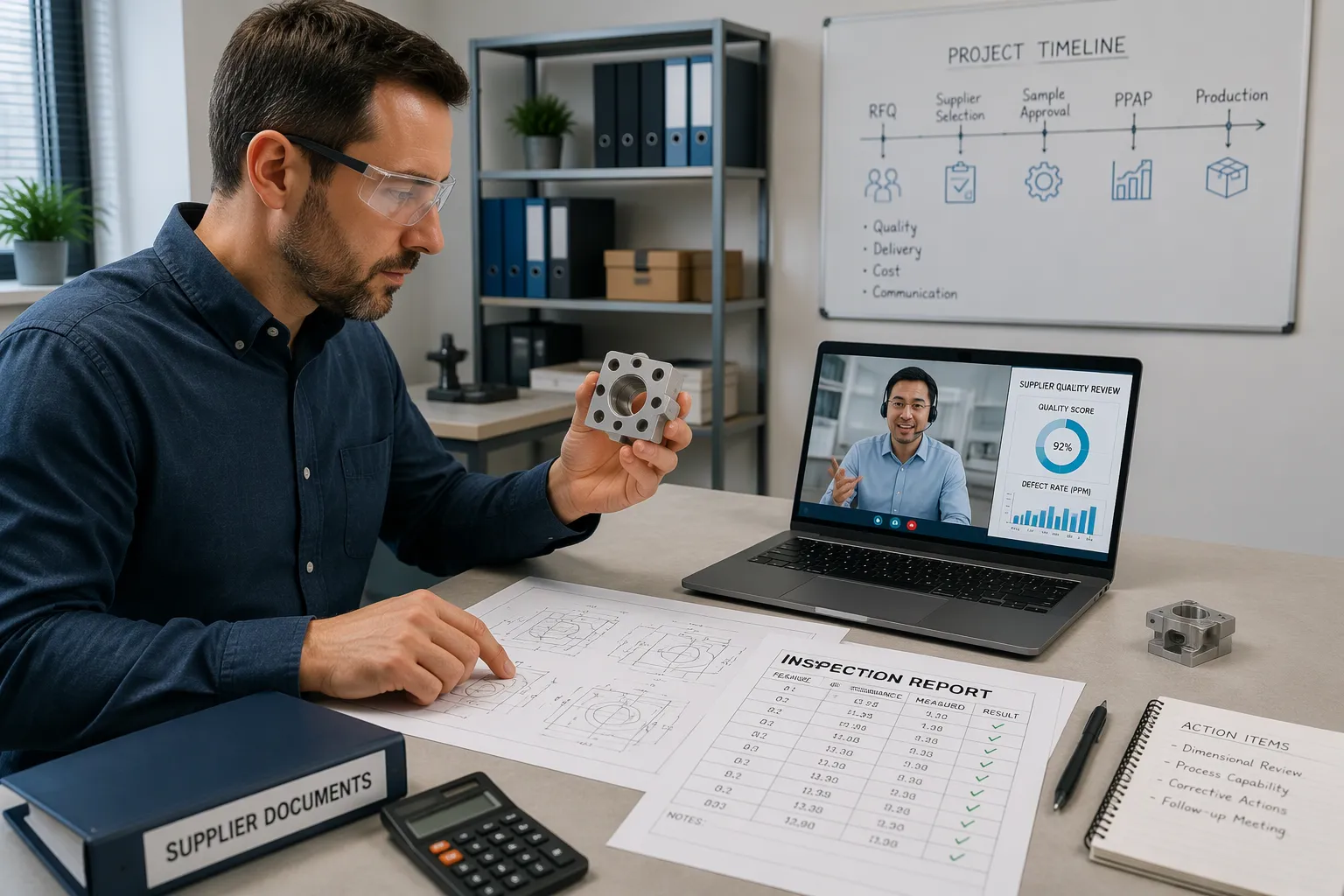
Ask for samples made to your spec sheet, not pulled from stock. Pay for them. A free sample tells you little about how the supplier will handle your real order. Test each unit against every critical dimension and performance target you wrote down. Put the results in a table so you can compare suppliers side by side later.
Engineering support is what separates a capable partner from a capable machine shop. Send a drawing with one deliberate ambiguity and watch how the supplier responds. A strong team flags the gap, asks a focused question, and proposes a tolerance that fits your application. Weak engineering support accepts the drawing without comment and ships whatever the line produces.
Judge engineering and process depth during sampling. Ask who reviews drawings, how the supplier validates a new tool, and what tooling capability it holds in-house. Request the sampling timeline and compare it with the promise. Slow, silent sampling predicts slow, silent production. Fast feedback with clear reasoning predicts a partner who solves problems before they reach your line.
Ask for the business license, recent tax records, and audited or bank statements where the supplier can share them. Read them for stability, not for secrets. Look at revenue trend across several years, debt levels, and whether the company pays tax on time. A supplier with steady revenue and clean tax records carries less risk of stalling mid-order. Treat missing documents as a question to ask, not an automatic rejection.
Map the supply chain behind your product. Ask which materials the supplier sources directly and which come through sub-suppliers. Request the names of key material sources and the controls applied to sub-suppliers. Then ask about backup capacity: what happens if a key material runs short, and which alternate source the supplier would use.
Review logistics arrangements last. Confirm the shipping ports the supplier uses, the Incoterms it quotes, and how it handles documentation for your destination. A supplier with diversified material sources, controlled sub-suppliers, and tested logistics routes protects your schedule. A supplier with a single source and no backup plan passes risk straight to you.
Samples and a pilot order complete this stage of the supplier verification process. Combine the sample results, the engineering feedback, and the financial and supply chain picture into one file. That file lets you verify a chinese supplier on evidence rather than impressions. It also feeds directly into the scoring step, where you compare candidates and decide who earns the trial run.
Make a weighted scorecard before you compare quotes. Score each candidate only on evidence you collected in the earlier steps. Technical performance covers sample test results against your spec sheet. Application fit covers engineering feedback and how well the supplier understood your use case. Regulatory compliance covers checked certificates and product approvals. Cost covers the landed price, not just the unit quote.
Criterion | Evidence source |
|---|---|
Technical performance | Sample test table |
Application fit | Drawing review and sampling feedback |
Regulatory compliance | Verified certificate numbers |
Cost | Landed price and payment terms |
Give weights that match your priorities, then score every candidate on the same scale. A supplier with strong samples and weak compliance scores lower than the raw test data suggests. This step lets you verify a chinese supplier on a level field and compare oem manufacturing in china candidates without bias toward the loudest sales pitch.
Negotiate pricing, lead times, payment options, and inspection and acceptance criteria all at once. Write the acceptance criteria into the oem contract manufacturing agreement. Define pass and fail before the run starts. State the sample size, the defect threshold, and the remedy for a failed lot.
Run the trial as a small version of the real order. Use the same lines, the same materials, and the same quality checks. Watch production capacity in practice, not on paper. Track quality consistency across the run and compare the actual schedule with the promised one. A factory audit predicts performance; the trial proves it.
Treat samples and a pilot order as the final gate. A clean pilot run and mass production readiness justify the large commitment. A failed pilot costs little now and saves far more later. Confirm the chinese supplier meets every criterion before you release the full order, and keep the pilot records as your baseline for future factory audits.
Think of these steps as one plan for making a decision. You go from written requirements to desk review, factory audit, technical and financial checks, scoring, and a trial order. Each stage removes a specific risk before the next one starts.
Copy this checklist before you commit:
Specifications defined
Factory status and MOQ confirmed
Certifications verified
Factory audited
Samples tested
Financials reviewed
Suppliers scored
Trial order passed
Now take action. Ask your shortlist for quotes and audit dates. Schedule the factory visit. Write down the trial-order acceptance criteria, including sample size and defect thresholds. A supplier that passes every gate earns your large order and your confidence in its quality.
Plan for one full day on site for a mid-sized facility. Add travel time and a follow-up visit if you find gaps. A short walkthrough rarely shows capacity or quality control problems. Give yourself enough hours to trace incoming materials, production lines, testing, and storage without rushing.
Partly. You can review its certifications, financials, and references. You cannot audit production lines it does not own. Ask which factory makes your product and request an audit there. Many trading companies handle this well. Confirm the arrangement in writing before you travel.
Contact the issuing body directly. Use the contact details on the certifier's own website, not the ones the supplier provides. Confirm the certificate holder name, the scope, and the expiry date. Match the scope to your exact product model. A valid number with the wrong scope still fails.
Size it to prove the process, not to fill your warehouse. Use the same lines, materials, and inspection steps as the full run. Set the sample size and defect threshold in writing first. A small run that passes your criteria gives you real evidence of consistency.
Watch for vague answers about factory ownership, certificate numbers you cannot confirm, and reluctance to allow an on-site visit. Slow or silent sampling also warns you. Any one of these deserves a direct question. A supplier that avoids verification will likely avoid accountability later.
Identify a suitable manufacturer in China for fish tape tools by checking specs, capacity, certifications, customization, cost, and contracts. This checklist guides you.
Find out more about our news >
To manufacture private label tie down straps, screen factories for experience, certifications, and custom printing. Request samples, verify compliance, and lock terms.
Find out more about our news >
Learn how to find a cargo net factory that supports recurring bulk orders. Vet capacity, quality systems, and scalability to secure a reliable supply partner.
Find out more about our news >
To find a reputable luggage strap manufacturer in China, research hubs, vet credentials, test samples, and negotiate clear terms to protect your brand.
Find out more about our news >
Use these 10 tips to verify a reliable Chinese supplier of EPDM rubber products. Check certifications, test samples, and confirm quality before you order.
Find out more about our news >
As an important international trade fair, the Canton Fair attracts merchants from all over the world to come and discuss cooperation. From April 15 to May 5, Aolu Industry and Trade Co., Ltd. participated in the fair with its core products and exchanged ideas with merchants from home and abroad.
Find out more about our news >