
 EN
 English
 Vietnamese
 繁体中文
 Italian
 Spanish
 Thai
 Japanese
 Portuguese
 Korean
 Russian
 French
 German
 Arabic
Stay Updated with Allroad’s
Industry Knowledge
Industry Trends, Product Knowledge & Global Trade Insights

Industry Trends, Product Knowledge & Global Trade Insights
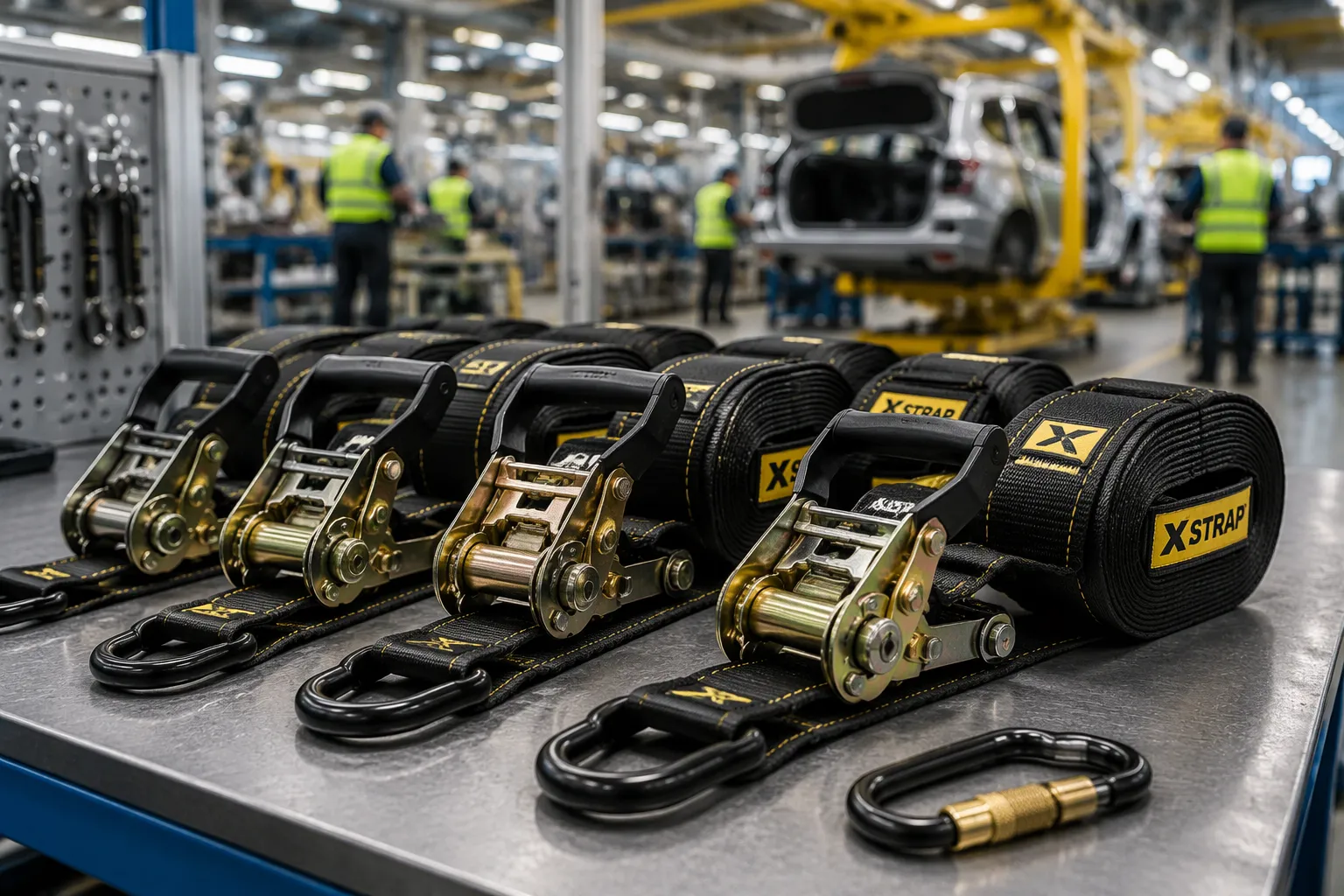
You run an automotive accessories brand, and you want tie-down straps sold under your own name. Your first step is a focused search: check trade shows, B2B platforms, sourcing agents, and buyer's guides. Use the right keywords to find factories that manufacture private label tie down straps. From there, this post walks you through a qualification sequence. You screen each factory, request samples, check compliance, compare costs, and manage the order. Treat every step as a filter. The private-label partner you keep is the one that clears all of them.
Use exact search words, and look at trade shows and B2B sites to find factories you might work with.
Make sure a supplier is a real factory. Ask for business licenses and video tours.
Ask each supplier for samples and compare their prices using the same specification sheet.
Make sure the factory can print your logo and package your brand the right way.
Set the payment, lead time, and private label ownership terms in writing before you pay.
You have four useful ways to look. Trade shows let you meet sales teams and ask them questions face to face. B2B platforms give you a lot of choices, but you have to filter them carefully. Sourcing agents know local ratchet strap suppliers and can make your list shorter. Buyer's guides to top ratchet strap manufacturers give you a starting point that is already checked.
Search with specific terms: "custom ratchet strap suppliers in the uk and europe," "ratchet strap supplier for european buyers," and "chinese ratchet strap supplier for europe." These phrases bring up well-known names. DOT Tiedown works for buyers who want a North American base. US Cargo Control, with its Iowa facility, fits brands that need shipping within the country. CTD USA in Hubbard, Oregon, works well for West Coast distribution. Ratchet Straps USA and CustomTieDowns serve buyers who want a wide range of products. Mac's Custom Tie-Downs fits performance and specialty uses. NW Straps suits local programs. Each one is a real ratchet strap manufacturer, and each fits a different supply plan.
A buyer's guide is really helpful here. It tells you which are true factories and which are trading companies, and that difference protects your quality control. A trading company cannot show you real production. Ask for photos of the production floor with your name on a sign. Ask for a video call that shows the machines. Check the business license for "Manufacturing" in the business scope, and compare the factory address they give with the registered address.
Use these checks as your filter:
Ask for the business license and export license, then check how long the company has been in business.
Treat five or more years with manufacturing listed as a good sign.
Treat a company under one year old, or one without manufacturing listed, as a warning sign.
Notice if they refuse a video call or factory tour. A real manufacturer is glad to be open.
These steps work the same for a chinese ratchet strap manufacturer and for a european ratchet strap manufacturer. Use them on every ratchet strap supplier on your list before you spend time on sampling.
Experience is what sets a real factory apart from a reseller. Ask how long the company has made straps, which markets it serves, and what design work it does in-house. ALL ROAD, for example, started in 2004 in Zhejiang Province, China. It now exports to more than 50 countries and offers in-house R&D plus OEM/ODM services. The company backs custom work with patents, datasheets, and lab and third-party test reports. Use this profile as a benchmark when you screen a chinese ratchet strap supplier for europe. A mature oem ratchet strap manufacturer backs custom work with patents, datasheets, and test reports. Ask for the R&D team size and annual new product count. Request datasheets for your target models. Compare several ratchet strap manufacturers on these points before you shortlist. Ask each ratchet strap manufacturer about custom printed ratchet straps and private label tooling. The strongest ratchet strap suppliers in europe keep a deep certification file and answer document requests quickly. Most ratchet strap suppliers in europe publish their certificate lists online. A european ratchet strap manufacturer may hold local stock, while an Asian factory may offer more custom tooling. Compare european ratchet strap manufacturers on lead time and tooling cost.
Certificates mean nothing until you check them. Start with the management system documents. ISO 9001 covers quality management, ISO 14001 covers environmental management, and BSCI covers the factory audit that most EU and US retail vendors require at onboarding. Then check product approvals: TUV/GS, CE, UL, and RoHS. The truckbrotools guide lists these credentials and their scope.
Certification / Standard | Scope | Why buyers ask for it |
|---|---|---|
GS, tested to EN 12195-2 | Product safety for lashing assemblies | Required or expected by German and EU retail chains |
EN 12195-2 test report | Lashing capacity (LC) in daN | The technical basis for EU market claims |
BSCI | Factory audit | Mandatory for most EU/US retail vendor onboarding |
ISO 9001 | Quality management system | Signals process discipline across batches |
California Prop 65 / REACH | Chemical safety | US and EU chemical compliance |
Ask for the full certificate PDF, not a logo. Check the report number with the issuing lab, such as TÜV, SGS, Intertek, or Bureau Veritas. Match the certificate to your exact product: webbing width, lashing capacity, and end fitting type. GS certificates typically run five years with surveillance audits. BSCI audits stay valid for about 12 to 24 months. Test random production straps against certificate values.
European buyers need one more check. EN 12195-2 is the harmonized standard for web lashings, and en 12195-2 compliant ratchet straps carry a blue label for two-part assemblies. The label shows LC in daN, STF, SHF of typically 50 daN, elongation at LC of no more than 7%, material marked PES, and the manufacturer name. The nbtiedowns sourcing guide notes that webbing color signals LC under this standard.
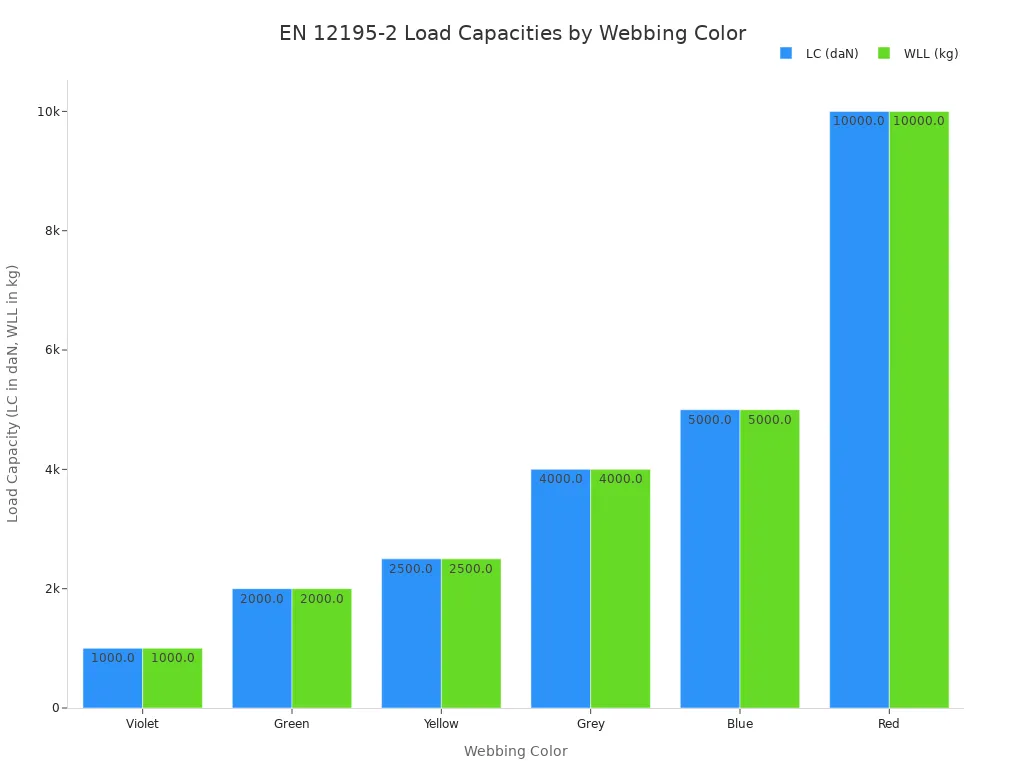
Violet webbing rates 1,000 daN, green 2,000 daN, and red 10,000 daN. The wrong color fails roadside inspection in Germany or the Netherlands, whatever the tested strength. Note that en 12195-2 ratchet straps do not carry a CE mark. Ask for an EC Declaration of Conformity and a type test report instead. A reliable ratchet strap supplier for european buyers will explain this difference without prompting. Ask ratchet strap suppliers for batch test records. Shortlist ratchet strap suppliers that answer fast. Check that ratchet strap suppliers match labels to certificates before approval.
A sample request is a way to spell out your specs, not a favor. Tell each ratchet strap manufacturer your market, how you will use the strap, anchor details, the working load limit or lashing capacity you need, overall and fixed-end lengths, quantity, and what documents you need. Force Rigging's buyer guide suggests this full brief. That way the factory can review dimensions, rated strength, color, function, materials, end fittings, marking, and packaging before production.
Ask for a sample or drawing when the anchor connection or packaging is customized.
Put a timeline in writing. Ask when the sample ships, which spec sheet comes with it, and which test reports cover the exact assembly. Request batch test records for strength and label data. Compare ratchet strap suppliers on how fast they respond and how good their documents are, not just on sample photos.
Line up every quote against the same specification sheet before you compare prices. Grandlifting's RFQ guide warns that a lower unit price may simply leave out a requirement another supplier included. Build a comparison sheet with one line per field: assembly rating, webbing, hardware, finish, labeling, packaging, test documents, delivery term, and quantity. Mark exceptions clearly.
Keep recurring unit prices separate from one-time charges for tooling, molds, artwork setup, printing plates, testing, certification, samples, and packaging development. Ask for quantity price breaks when forecasts are uncertain. Request a lead-time breakdown covering sample preparation, approval, material booking, mass production, inspection, and shipping. A single total lead time hides dependencies.
Use the TruckBroTools checklist to confirm each quote covers the complete assembly: WLL and break strength, webbing material and width, ratchet and end-fitting specs, stitching and traceability, testing for your destination market, and private-label packaging. This lets you compare equivalent assemblies across ratchet strap suppliers in europe and beyond. Shortlist ratchet strap suppliers that answer spec questions fast. The best european ratchet strap manufacturers and Asian factories both win on clarity, not on the lowest number.
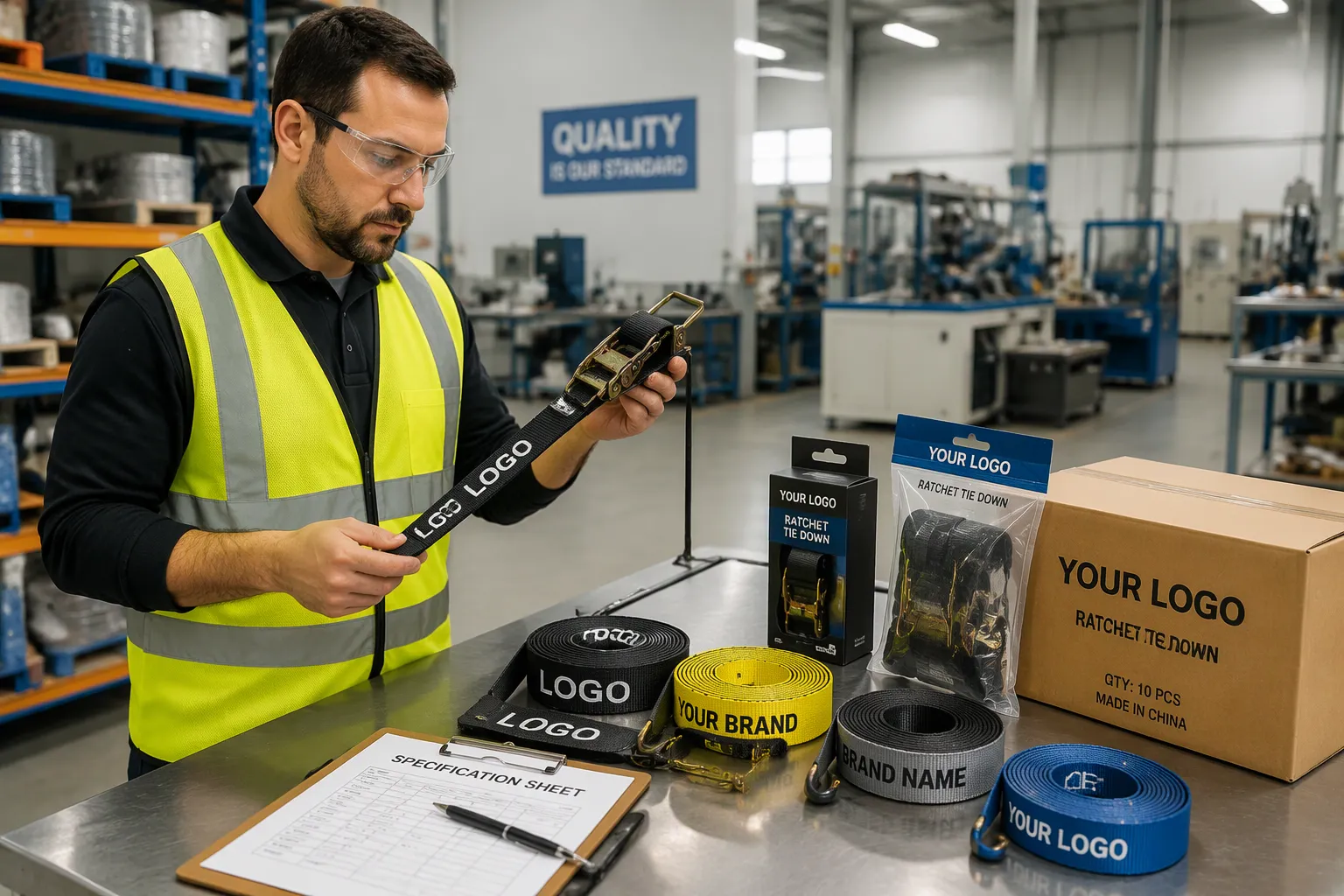
Printing turns a generic strap into your product. Ask each factory which methods it runs in-house. CTD USA lists direct print and sublimation among its webbing options. Sublimation lets the webbing match a Pantone color, a pattern, or a specialty design. CustomTieDowns separates two paths. Custom text printing suits names, phone numbers, and short repeating messages, with low minimums and no setup fee. Full design printing suits logos, artwork, and precise brand colors, with single- or double-sided output and Pantone matching. Expect higher minimums and longer lead times on that second path.
The nbtiedowns guide compares three methods for custom printed ratchet straps. Screen printing keeps unit cost low and samples fast, and it works on standard polyester webbing. Heat transfer and sublimation fuse ink into the fiber for sharper multi-color logos and better abrasion resistance. Jacquard weaving builds the logo into the webbing itself, the most durable route for heavy professional use, at a higher minimum order quantity and price. Match the method to your channel. A value line fits screen printing. A retail kit fits sublimation. A fleet brand fits jacquard.
Labels and packaging carry your brand past the factory gate. Megacrocgear lists branded labels and cartons, carry bags, retail-ready packaging, custom pack quantities, and formats built for e-commerce and distribution. Ask for polybags, clamshells, retail boxes, master packs, and shipper displays. CustomTieDowns confirms full-service production from raw material through finished retail packaging and custom shipping cartons. Request a physical packaging sample before you approve the run.
Then test the sample against your own specification sheet. Check the rated strength against the certificate value. Inspect every hardware part: ratchets, cam buckles, hooks, rings, and fittings. Confirm the finish, the stitching, and the print placement. CTD USA stocks over 1,000 tie-down components and over 200 webbing types, with widths from 1 to 8 inches and strengths from a few hundred pounds to over 78,000 lbs. That range supports custom ratchet straps across most vehicle classes. Its in-house metal forming, welding, and machining keep hardware quality under one roof. A factory that can manufacture private label tie down straps will document each check. Ask for the inspection record with the sample. Compare two custom printed ratchet straps side by side under load. Confirm the factory can manufacture private label tie down straps at your volume before you commit. Strong oem and private-label production shows in the sample, not the brochure. Order wholesale oem logo tie down straps only after the sample passes. Treat private label straps and private-label straps as the same promise: your name, your spec, their build. Reliable private-label production partners prove custom printed ratchet straps and branded ratchet tie-downs meet your standard. High-volume private-label work needs a factory that repeats that standard on every batch. Confirm they can manufacture private label tie down straps before you sign.
Write down every business term before you send money. A sales rep's verbal promise means nothing when a shipment is late. Confirm these points in the contract or proforma invoice:
Unit pricing and the currency, plus how you will handle price changes on repeat orders.
Minimum order quantity per SKU and per color, not just per order.
Lead time from deposit to ex-factory date, with the sample approval date as the clock start.
Payment schedule, usually a deposit with the balance against a copy of the bill of lading.
Inspection rights, including who pays for a third-party pre-shipment inspection and what defect level triggers a rework.
Private label ownership: artwork files, print plates, molds, and label designs stay your property.
That last point protects your brand. Ask the ratchet strap manufacturer to confirm in writing that it will not sell your printed design to another buyer. Keep your own copy of every approved spec sheet and signed sample.
Set milestone checks and hold the factory to each one. After you pay the deposit, ask for written confirmation of the material booking date and the production start date. Ask for photos of the webbing and hardware before assembly begins. Mid-production, ask for a progress update with output counts against your order quantity.
Before shipment, book a pre-shipment inspection through a third party or send your own inspector. Check the assembly against the approved sample: webbing color, print placement, hardware finish, label text, and packaging. Compare the inspection report to your spec sheet line by line. Approve shipment only after the report passes.
After delivery, review the batch against the test records. Track defect rates and on-time performance across your first few orders. Compare ratchet strap suppliers on these results, not on their sales pitch. A supplier that hits every milestone earns repeat business. A supplier that misses them teaches you where to tighten the next contract. Use the first order as a test, and let the data decide the second. Reliable ratchet strap suppliers treat your milestones as their own.
Your path to a factory that can manufacture private label tie down straps follows six steps:
Search the sourcing channels.
Screen each supplier.
Request samples.
Evaluate the build and the documents.
Negotiate terms.
Monitor production.
Before you commit, confirm five decision points. You need verified strap experience, valid certifications, an approved sample, clear private-label terms, and agreed MOQ and pricing. Start with one channel and one shortlist this week. Treat the first order of your tie-down straps as a test of the factory relationship, and let the results guide your next order.
Times differ by factory and order size. Ask each supplier for a written plan that covers sample prep, approval, material booking, mass production, inspection, and shipping. One total lead time can hide steps that depend on each other. Compare these plans side by side before you agree to a schedule.
Yes, as long as your order fits the factory's minimums. Ask for the MOQ for each SKU and each color, not just for the whole order. Some factories set lower minimums on standard webbing and higher ones on custom printing. Get the numbers in writing before you pay a deposit.
Ask for the full certificate PDF, not just a logo. Check the report number with the lab that issued it, such as TÜV, SGS, Intertek, or Bureau Veritas. Make sure the certificate matches your exact product: webbing width, lashing capacity, and end fitting type. A top factory like ALL ROAD holds ISO 9001, ISO 14001, and BSCI, plus TUV/GS, CE, UL, and RoHS approvals.
Book a pre-shipment inspection through a third party, or send your own inspector. Compare the assembly to your approved sample: webbing color, print placement, hardware finish, label text, and packaging. Approve shipment only after the report passes. Track defect rates and on-time performance, then let that data guide your second order.
Get it in writing that artwork files, print plates, molds, and label designs stay your property. Ask the factory to agree it will not sell your printed design to another buyer. Keep your own copy of every approved spec sheet and signed sample. These records protect you if a dispute comes up later.
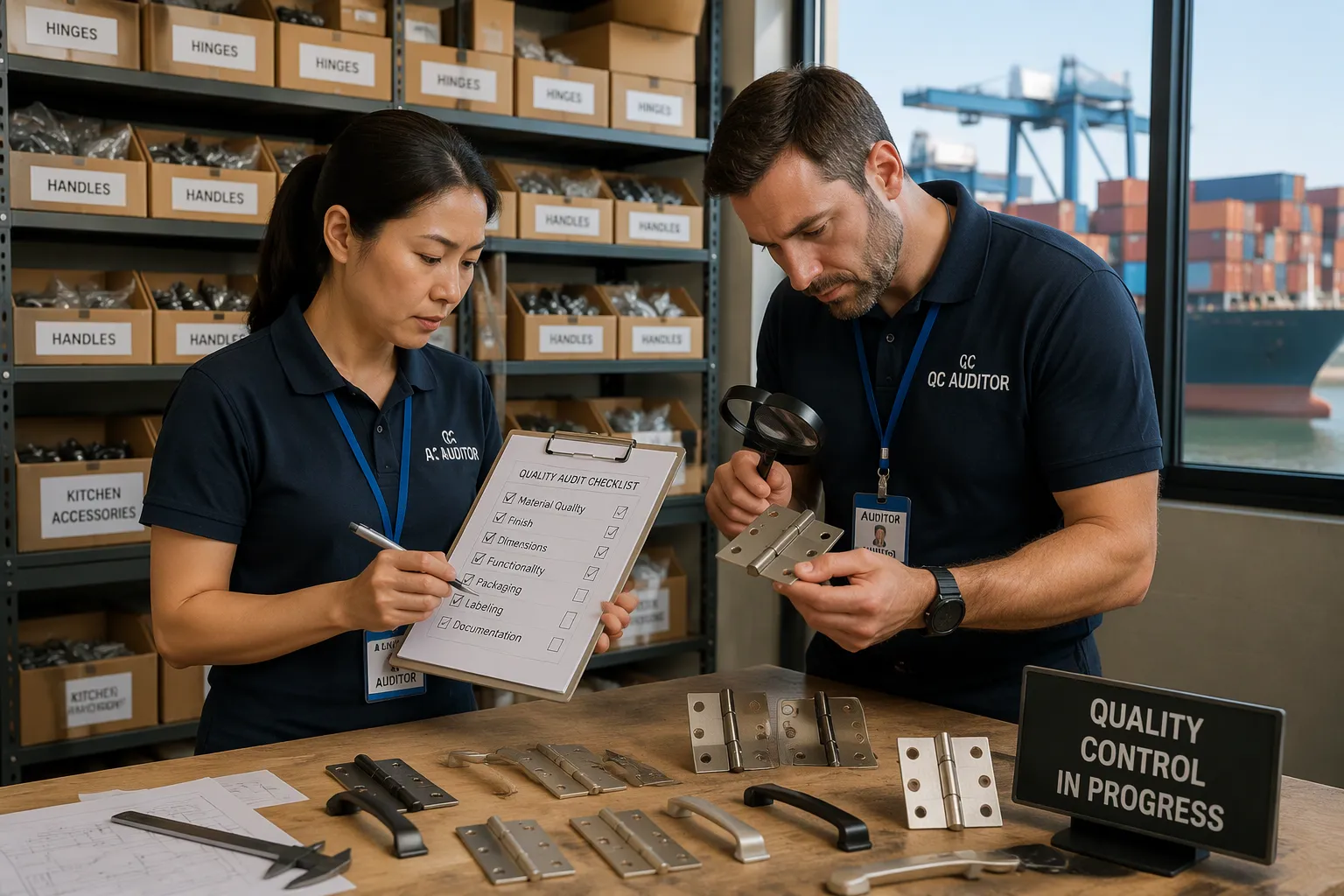
Verify the BSCI-audited factory's report and grade, then assess technical performance, application fit, compliance, and cost to secure your supply chain.
Find out more about our news >
Assess manufacturing capabilities of a Chinese OEM supplier by defining specs, auditing the factory, testing samples, checking finances, and running a trial order.
Find out more about our news >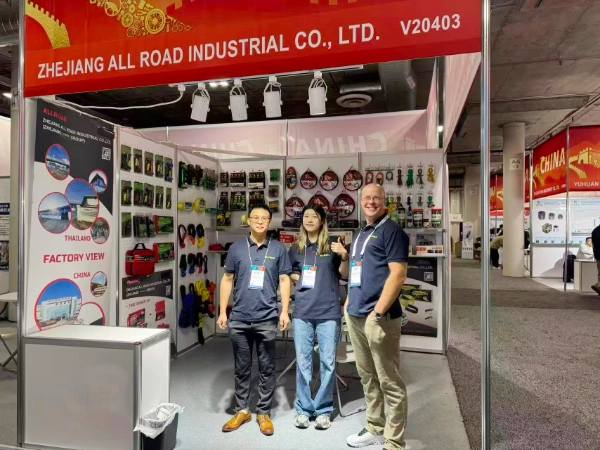
In November 2026, AAPEX 2026, one of the world's leading automotive aftermarket events, was held in Las Vegas, USA.
Find out more about our news >
To find a reputable luggage strap manufacturer in China, research hubs, vet credentials, test samples, and negotiate clear terms to protect your brand.
Find out more about our news >
Here are 7 tips to find a manufacturer for hardware accessories that supports flexible designs and efficient production, ensuring your project succeeds.
Find out more about our news >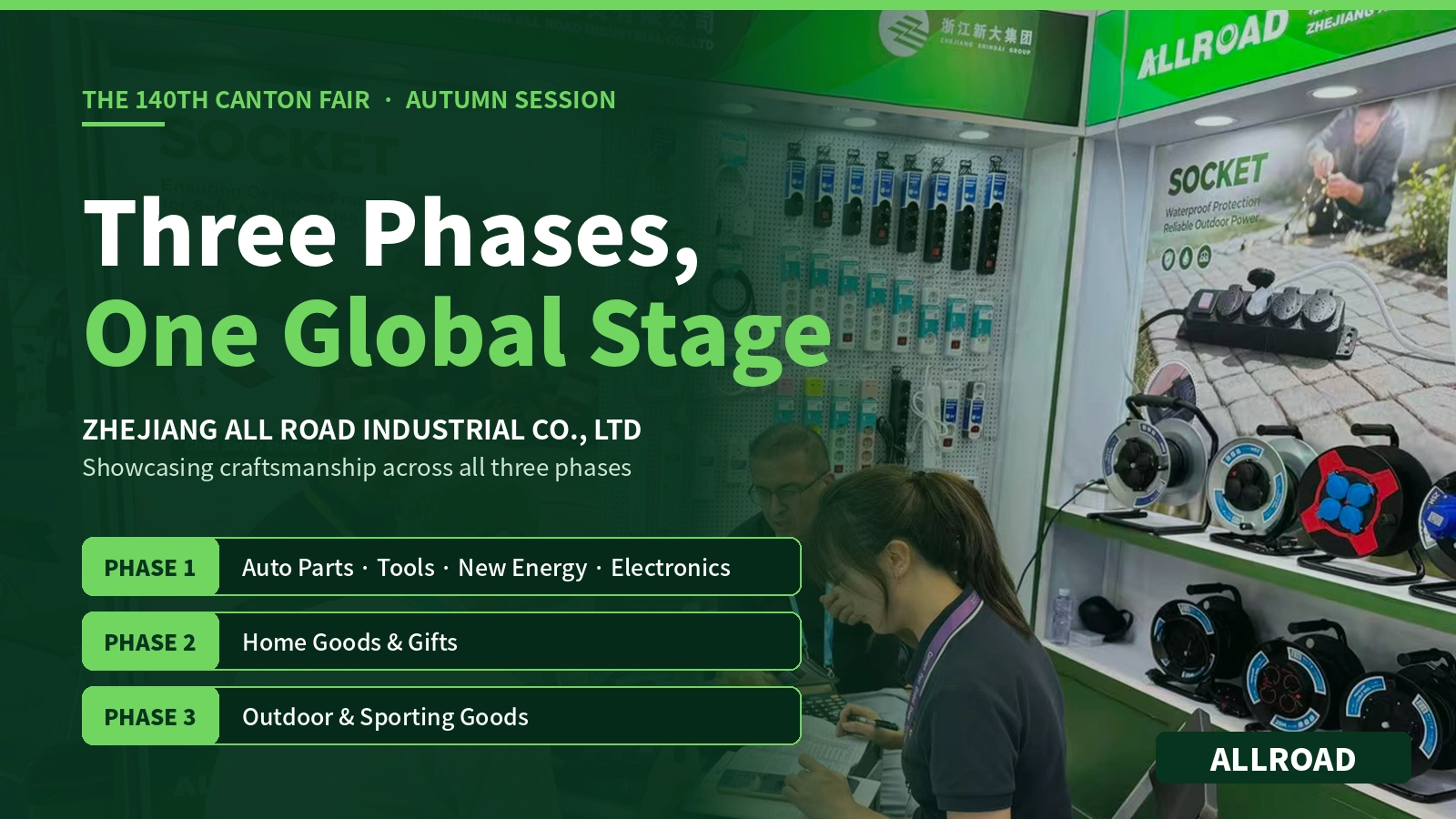
Zhejiang All Road Industrial Co., Ltd. Showcases Craftsmanship at the 140th Canton Fair (Autumn Session) and Engages Buyers from Around the World
Find out more about our news >